

Appeasement in Business: Knowing When the Terms No Longer Work
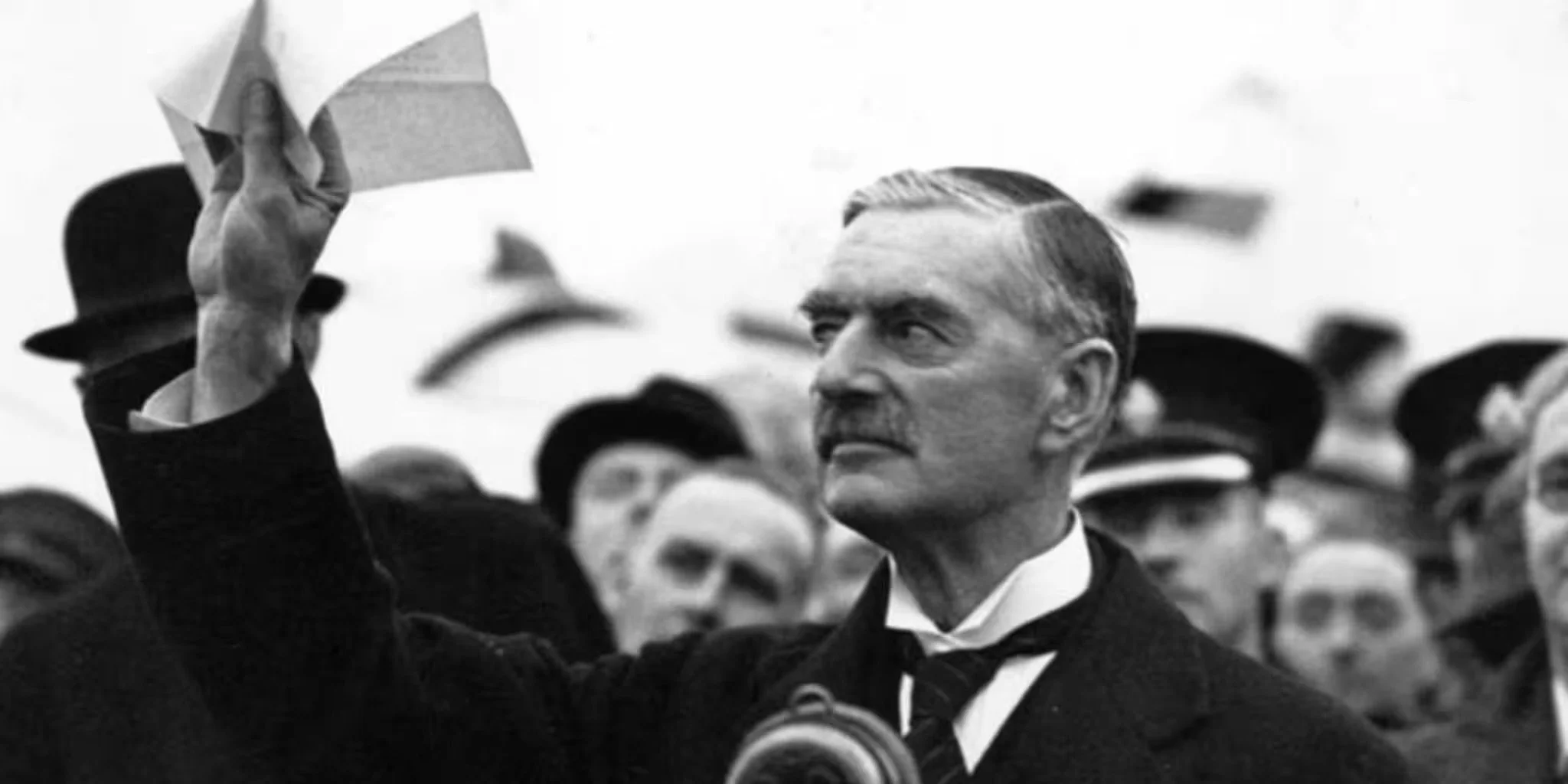
Neville Chamberlain returning from Munich in September 1938.
I recently finished Martin Gilbert's The Roots of Appeasement. When most of us hear the word appeasement, we think of Neville Chamberlain's negotiations with Hitler's Germany and the 1938 Munich Agreement. Gilbert shows that the policy started much earlier. Its foundations were laid at the end of World War I, long before Hitler came to power.
WWI was the first large scale war fought in the industrial age.
World War I was the first large-scale war of the industrial age. Machine guns, heavy artillery, and poison gas caused a loss of life and property on a scale not seen before.
The Treaty of Versailles, signed in 1919, required Germany to accept blame for the war, give up territory, and pay heavy reparations. Within a few years, the British government came to see those terms as more than Germany could sustain. British leaders feared that a resentful Germany would one day seek revenge. Their answer was to bring the German economy back into Europe, on the theory that close trading partners are less likely to go to war.

The French resisted, and it is easy to see why. Their towns and farms had been destroyed, and they wanted Germany kept weak. For much of the 1920s, Britain and France pulled in different directions on how to treat their former enemy.
Appeasement started for the right reasons. Gilbert draws a line between an early, hopeful version of the policy and a later version driven by fear. The early version aimed for a fair and lasting peace. Chamberlain failed to recognize that the policy was doomed once Hitler took power in 1933. By the time Chamberlain became prime minister in 1937, the conditions that had justified appeasement were gone, but the policy stayed in place.
Appeasement happens in business as well.
The same pattern shows up in business. A decision made for good reasons stays in place after the conditions behind it have changed. In my experience, it appears most often in three places: keeping clients, winning new business, and mergers and acquisitions.
When a contract comes up for renewal, the goal is almost always to keep the relationship. What we often miss is how much both parties have changed. Each company's ideal customer or vendor profile may look different from what it was when the first contract was signed. If the relationship came to us today as new business, it might not meet marketing or sales qualifying criteria.
I worked with one company that had a strong relationship with a local service provider. Through acquisitions and growth, the company quadrupled in size in less than five years. The service provider could no longer support the whole organization. The reasons for not changing were familiar. The provider had a good track record, people liked working with them, and too many other things were going on.
Negotiating a large new contract creates a different kind of pressure. The bidder wants to win a new strategic client. Once a deal shows up in the pipeline reports, the sales team feels strong pressure to close it. Meanwhile, the client keeps negotiating for what it believes is the best deal possible. Too often, the negotiation turns into a race to be cheaper.
As the proposal changes, neither side goes back to the original deal assumptions. The seller does not check whether the deal can still meet margin targets within an acceptable risk profile. The buyer does not check whether the reduced scope still meets the original business objectives. Both sides can end up signing a contract that neither would have accepted at the start.
For all of these reasons and more, mergers and acquisitions are even harder to walk away from. Once a deal becomes public, neither side wants to lose face by backing out. DaimlerChrysler's 2000 deal with Mitsubishi Motors is a well-studied example. Researchers traced its collapse within four years to failed integration, and Daimler's board later ended the relationship. I wrote about these pressures in two earlier newsletters, listed in the related articles below.
Appeasement can also come from outside a deal. In 2023, a Bud Light social media promotion led to a customer boycott, and the company's response tried to avoid taking a side. Critics kept up the boycott, while supporters criticized the company for neither standing behind the influencer nor admitting a mistake and changing course. A year later, researchers writing in Harvard Business Review found that sales had not recovered. When a company tries to avoid conflict with every group at once, it can lose everyone's trust.
In each of these cases, the original decision made sense. The risk comes from carrying it forward without asking whether the conditions behind it still hold. One useful habit is to review long-standing relationships and active deals as if they were new. Would we pursue this client today? Would we sign this contract at this price and scope if it came to us fresh? Knowing what we know now, would we announce this deal again?
These questions matter most when a company reaches a turning point, such as rapid growth, an acquisition, or a shift in its market. At those moments, managing existing commitments well is not enough, and the commitments themselves may need to change. It is a bit like boarding a train in New York bound for Chicago when the real destination is Miami. Every mile on the wrong train makes the trip longer. Checking the destination before the train leaves costs far less. It lets the choices we make today lay the foundation for where we need to go next.
Peace bought with silence grows costly over time. Reassess your goals.
Related articles
When Winning the Deal Can Become a Curse | LinkedIn
Three Cheers for the Courage to Say No | LinkedIn
Netflix Lost the Warner Bros. Bidding War and Walked Away With $2.8 Billion | Moneywise
Lessons from the Bud Light Boycott, One Year Later | Harvard Business Review
Boycott or Buycott: The Aftermath of Corporate Activism | NIM Marketing Intelligence Review
Chips And Salsa: Bite-Sized News and Posts
Here are a couple of articles that explain why diesel prices matter and why tax or trade policy has a hard time moving them.
Diesel Fuel Hit a Record High. Unlike Gas, Using Less Is Not an Option | Marketplace
How Banning Diesel Exports to Lower Prices Could Backfire | Marketplace
Stress is a fact of life. How we respond is often a choice.
How to Make Stress Work for You | Nir and Far
One gap in the U.S. educational system is that we do not teach foreign languages as a core part of the K-12 curriculum. That puts us at a disadvantage compared with most other industrialized nations.
Learning Another Language May Help Keep Your Brain Healthy as You Age | The Conversation
My wife and I ate at a tapas restaurant this weekend after visiting the Banksy exhibit in Atlanta. The food was great, and the design was modern industrial, with concrete floors and exposed ceilings. The place was full, and because no one could hear well, everyone ended up shouting to be heard. I wish more places would consider noise-dampening designs.
Noise Pollution Is a Serious but Often Forgotten Public Health Problem | The Conversation
There is a real chance that quantum computing will be more disruptive, more transformational, or both, than generative AI.
Q&A: How Will Quantum Computers Change Society? | Phys.org
Four More Teams Enter Quantum Benchmarking Initiative's Final Stage | DARPA
I believe some of the most evil people are those who wrap themselves in holy words, from any religion, to manipulate people for their own benefit.
Televangelist Jim Bakker Dies at 86: His Life in Photos | USA Today
There are two things going on in this article. First, top performers who treat colleagues badly can damage an entire organization. Second, because the results were strong, the CEO never addressed the cultural and performance issues, and when the final breaking point came, there was no transition plan.
Inflection points can be large or small. They are all opportunities to pivot. Take advantage of them.
When Your Team Loses a Member or Gains a New One, or Both? | Leigh Thompson on Substack
The Economy
Markets are strong, but I still believe the economy is fragile.
Goldman Sachs Shares a Blunt Message on U.S. Inflation | TheStreet
We need a U.S. debt conversation — will the Republicans have one? | Financial Times
The Numbers Behind the Bond Bear Market (with a Look at Equities | Ray Dalio via LinkedIn
IMF warns global economy nearing "limits of resilience" | Axios
More than tariffs and interest rates are affecting the economy. Our aging population is also putting pressure on economic growth. This article discusses the impact on Tampa Bay.
As Boomers Retire, Tampa Bay Faces an Economic Reckoning | Tampa Bay Business and Wealth
One of my recent newsletters on the economy.
The Economy Looks Strong. Why Does It Feel Fragile? | LinkedIn
Entertainment
This is an interesting list. My guilty pleasure is They Live, from the ridiculous five-and-a-half-minute fight scene over a pair of sunglasses to Roddy Piper walking into a bank with a shotgun shouting, "I have come here to chew bubblegum and kick ass. And I'm all out of bubblegum." Lists like these often overlook earlier movie history: many 1950s movies could make this one.
10 Great Sci-Fi Movies Where the Aliens Walk Among Us | WhatCulture
The Far Side on music.
The 10 Best Far Side Comics About Music | Polygon
Quotes
"It is hard to fail, but it is worse never to have tried to succeed."
Theodore Roosevelt
"The exemplary person pursues harmony, not sameness."
Sun Tzu
"A step backwards after making a wrong turn is a step in the right direction."
Kurt Vonnegut
Join the Conversation
Subscribe on LinkedIn, Medium, or Substack.
Leadership is the most important work we do—in business and in life. I've spent over 40 years working with leaders across more than 100 companies, and I'm still learning. These newsletters share my thoughts on leadership today and what we can learn.
I need your help making this better. What topics hit home? What misses the mark? What leadership challenges are you wrestling with right now? Send them my way.
I use AI to enhance my writing. All of the ideas, recommendations, and opinions are mine. To read about my process for leveraging AI, please read this newsletter.
Find The Leader With A Thousand Faces and other recommended books on my website.