
Cap, Gowns, and Boos: The Age of AI Discontent
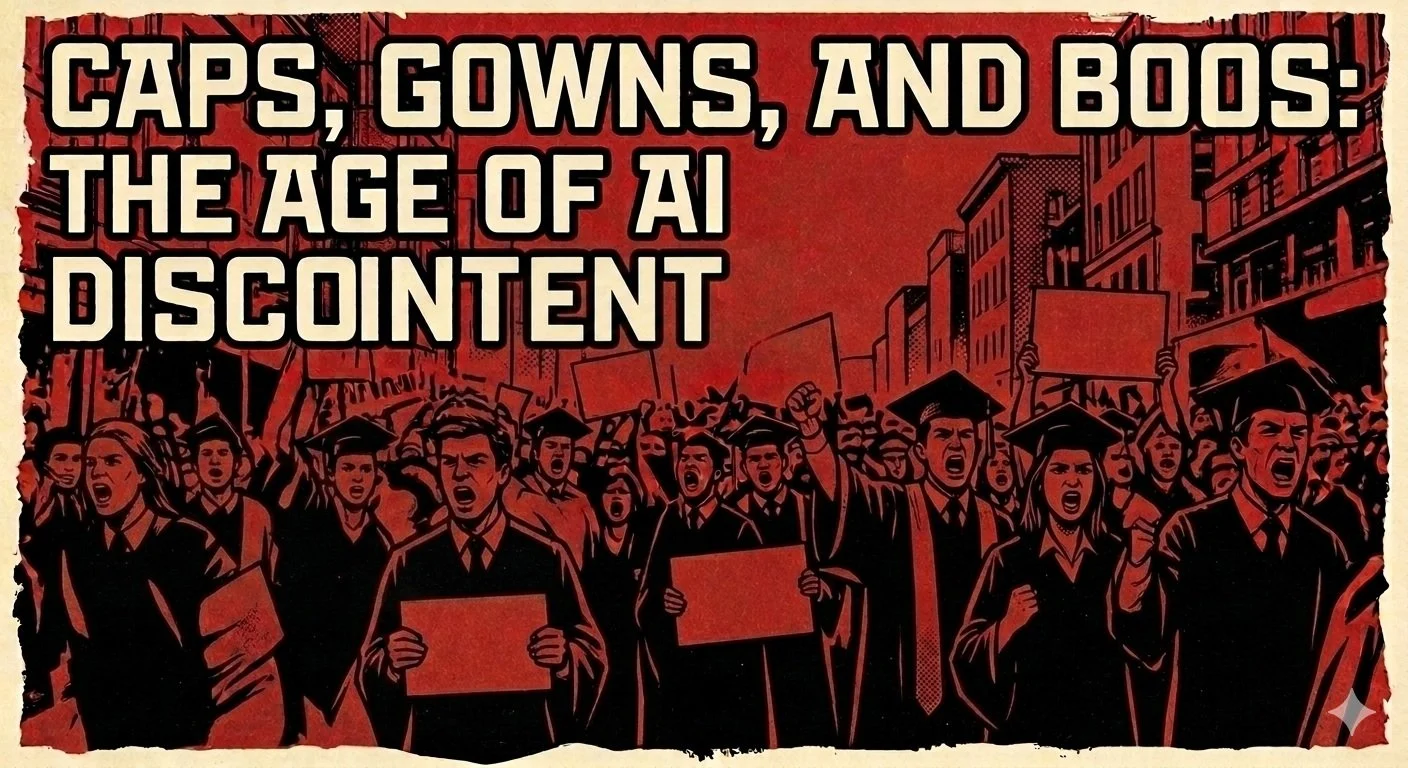
Image generated by Nano Banana
Something unusual happened at graduation ceremonies across the country this spring. When speakers mentioned artificial intelligence, the caps and gowns erupted not in applause, but in boos. Eric Schmidt, former CEO of Google, paused mid-sentence at The University of Arizona and asked the graduates, "If you'd let me make this point, please …" The crowd only grew louder.
It is a story about fear, uncertainty, and doubt meeting a tipping point.
We have seen this before. Every major wave of automation in history has generated the same response: anxiety, resistance, and eventually adaptation. Manufacturing workers watched machines replace them on assembly lines for two centuries. Telephone switchboard operators, a skilled profession of thousands, disappeared with the dial tone. Customer service representatives have been steadily replaced by chatbots for years, a shift that has been obvious and often frustrating. This is a tale as old as progress. (Feel free to hum a tune from Beauty and the Beast.)
What makes this wave feel different?
For decades, a college degree was sold as a safe harbor and the key to success. Analysis, writing, coding, legal research, and financial modeling were assumed to be immune to automation. Graduates are walking across the stage into a job market where the number of entry-level positions is contracting. The unemployment rate among recent college graduates aged 22 to 27 stood at 5.6% in March, compared to 3.1% for all college graduates. Competition for entry-level openings has intensified sharply, with one hiring platform reporting a nearly 22% year-over-year increase in applications per posting.
Then there is the mixed-message problem. These same graduates have been told to embrace AI but are often penalized for using it. Students have been expelled from universities over AI plagiarism allegations, while the same institutions deploy AI tools to grade their work and evaluate the papers to determine whether AI was used. One college in Arizona had to halt its graduation ceremony mid-stream when an AI name reader mispronounced and skipped students altogether.
The irony is hard to miss.
The layoff headlines have not helped. Companies, including Meta, Amazon, Oracle, Standard Chartered, and Cloudflare, have cited AI efficiency as a reason for cutting thousands of jobs in 2026. But there is more to that story than the press releases suggest. OpenAI's CEO, Sam Altman, acknowledged publicly that nearly every company doing layoffs is blaming AI, regardless of whether AI is truly the cause. Deutsche Bank analysts described the trend as "AI redundancy washing," a 2026 phenomenon in which restructuring decisions driven by financial considerations and the pressure to fund billion-dollar AI infrastructure investments get labeled as AI-driven efficiency gains. For the affected workers, the outcome the same either way.
Add to this the cultural backdrop. Dystopian entertainment has spent a century imagining rogue systems destroying jobs, undermining freedom, and eroding what makes us human. Every new headline about AI deepfakes, AI-generated spam flooding the internet, or AI writing students' essays for them reinforces the same narrative. Pope Leo XIV is preparing to release his first encyclical, "Magnifica Humanitas," on May 25th, dedicated entirely to safeguarding human dignity in the age of artificial intelligence. When the Vatican devotes its most significant teaching document to a technology, the conversation has clearly moved beyond the tech sector.
Now the boos make more sense.
So what do we tell the Class of 2026 -- and ourselves?
There is a story line in Hidden Figures worth remembering. Dorothy Vaughan learns that NASA is installing an IBM mainframe capable of replacing her entire team. Rather than waiting to see what happens, she stole a book on FORTRAN programming from the library, taught herself after hours, and then taught her team. When NASA announces it needs a programming staff, she tells them, "You don't need a team. You have a team." Her human computers became NASA's first programmers.
Vaughan did not celebrate the machine. She did not pretend it posed no threat. She simply refused to let it define the limits of what her people could do.
The instinct to move toward the disruption rather than away from it is the only strategy that has ever worked in the face of technological advancement. It was true for factory workers who became machine operators. It is true now for the writers, analysts, coders, and new graduates who are wondering what AI means for their careers.
We cannot pretend the transition is painless. Layoffs are real. Anxiety is reasonable. The graduates booing at commencement are not wrong to feel what they feel. But fear expressed as resistance has never stopped a wave of technological change. It has only determined who gets left behind.
Those who will navigate this moment well are the ones asking a different set of questions. Not "will AI replace me?" but "what can I do with AI that I could never do before?" Not "how do I protect what I have?" but "how do I prepare for what is coming?" Those are the questions that define moments of true inflection -- when the road ahead requires something beyond the steady state. They require transformation.
Or as Steve Wozniak said, "Remember that you have AI – Actual Intelligence."
Every age arrives,
Wearing the mask of a threat.
Most become a gift.
Related articles
Former Google CEO Eric Schmidt booed by graduates at mention of AI | BBC
AI Triggers Controversial Commencement Season | U.S. News & World Reports
Gen Z's AI backlash is getting louder | Business Insider
Pope Leo XIV's first encyclical Magnifica humanitas to be published May 25 | Vatican News
Standard Chartered to cut more than 7,000 jobs as it steps up AI use | The Guardian
Who’s Afraid of A.I.? | NYT DealBook
CEOs Say Layoffs Are AI’s Fault—But Some Experts Think Companies Are Lying | Forbes
‘A death penalty’: Ph.D. student says U of M expelled him over unfair AI allegation | MPRNews
Professor Reveals Shocking Reason Students Are Intentionally Writing Poorly | Newsweek
Why I Believe I Lost My LinkedIn Top Voice Badge (And Why It Reveals a Bigger Problem) | Mark Rapier
Building A New Path:: The 2026 Graduate Report | ZipRecruiter
Deutsche Bank declares ‘the honeymoon is over for AI’ — here’s why | CNBC
Chips And Salsa: Bite-Sized News and Posts
History is an excellent and challenging teacher. Analogies are incredibly useful if you take the time to understand how to adapt them to the current situation.
Iran as Vietnam, Ukraine as Korea | Foreign Affairs
Nothing like blaming someone who works for you for your mistake. This reminds me of people who missed their flight and blame TSA because the line was too long.
Garrick Higgo, days after curious PGA Championship penalty, splits with caddie | Golf
Steve Jobs was an innovative genius. It took him a very long time to learn how to be good at running a business.
5 ways Steve Jobs almost destroyed Apple | Fast Company
The quickest way to avoid falling into this AI trap is to do two things. Never forget that AI prepares your first draft, not the final product. (Don't be lazy.) Read the AI draft out loud and eliminate any phrasing that you would never say out loud.
This Very Subtle Yet Common Sign Screams 'AI Wrote This' | Medium
A great quote from Shaq: "Your character will take you further than your resume."
Despite a $500 million net worth, Shaq just finished his fourth degree. | Fortune
AI can help people create exceptional content. It can also create a lot of useless.
How Much of the Internet Is AI Slop? | Stat Significant
The real test of ads is whether they will change buying behavior. Will you buy something you have not tried before?
U.S. Ads: 10 of the Funniest Commercials on TV | Medium
Never underestimate the power of good design.
The Unsung Story of the Greatest Industrial Designer | American Business History Center
I wrote about the leadership lessons we can learn from the LIV-PGA competition. This article came out shortly after my newsletter.
LIV Golf Makes $250M Funding Demand to Save Face But Investor May Say No – Report | Essentially Golf
PGA vs. LIV - A Leadership Retrospective | Mark Rapier
The real test of ads is whether they will change buying behavior. Will you buy something you have not tried before?
U.S. Ads: 10 of the Funniest Commercials on TV | Medium
It's not just me – mind wandering is a real thing.
Quantum will be the next tech revolution.
Quantum sensors use atoms, electrons and light as ultra‑steady rulers | The Conversation
Quotes
“Never be afraid of being afraid.”
David Metzen
“Don’t underestimate the talent you already have.”
Tom Peck
“Go confidently in the direction of your dreams! Live the life you've imagined.”
Henry David Thoreau
Join the Conversation
Subscribe on LinkedIn, Medium, or Substack.
Leadership is the most important work we do—in business and in life. I've spent over 40 years working with leaders across more than 100 companies, and I'm still learning. These newsletters share my thoughts on leadership today and what we can learn.
I need your help making this better. What topics hit home? What misses the mark? What leadership challenges are you wrestling with right now? Send them my way.
Find The Leader With A Thousand Faces and other recommended books on my website.