

The Bill Nobody Wants to Pay: America's Debt Crisis and the Leaders Who Look Away

Photo by Alice Pasqual on Unsplash
We have been here before. We can all recognize the problem.
I have been writing about the federal debt since 2024. My argument has been consistent: this is not a political talking point or a budget footnote. It is an existential threat to our economic future, and we are running out of time to address it. With each passing quarter, the window for a manageable solution narrows a little more.
The growth of debt is a failure of leadership that has lasted throughout the 21st century. President Clinton left office with a balanced budget.
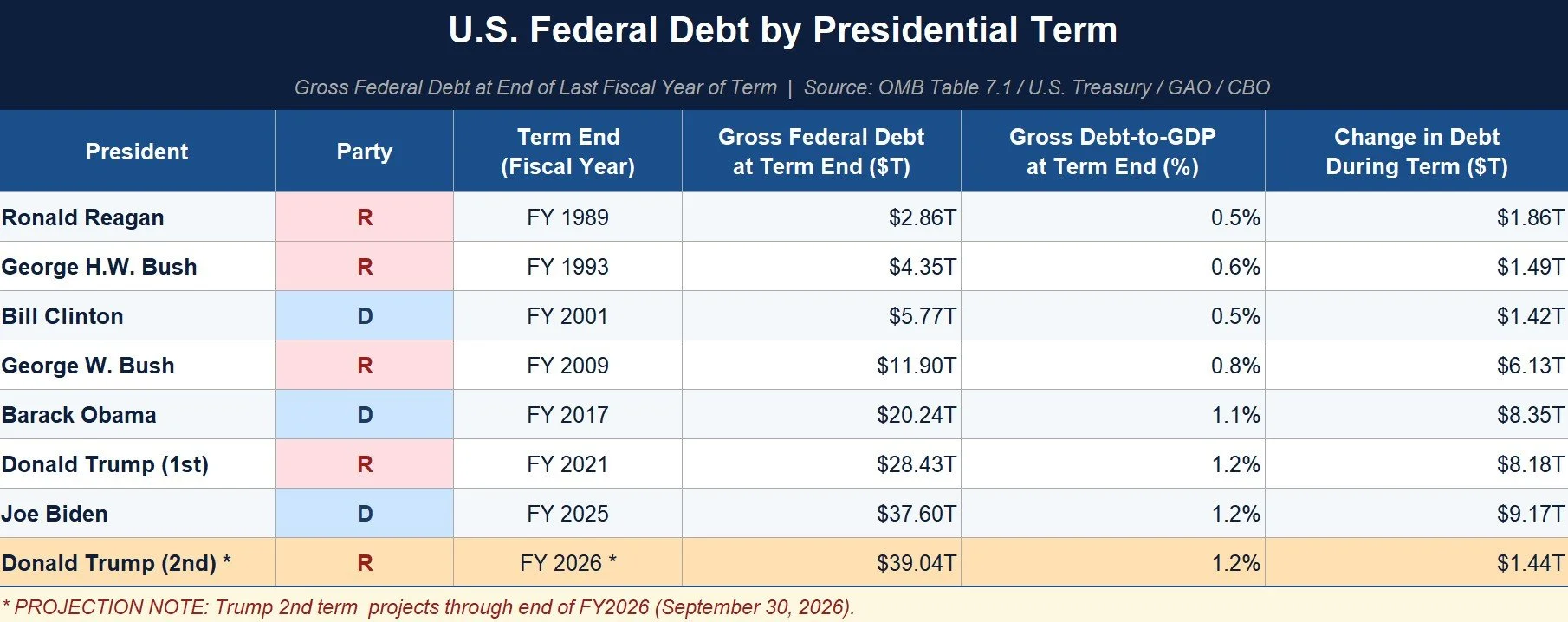
This table was created by Claude and is the result of multiple prompts.
The gross national debt now sits at $39 trillion. We now spend more on interest payments than we spend defending the country. In fiscal year 2024, net interest on the debt surpassed the entire defense budget. The Congressional Budget Office projects that gap will keep widening. By 2036, interest payments alone are projected to reach $2.1 trillion annually.
Ernest Hemingway captured the dynamic precisely. In The Sun Also Rises, a character is asked how he went bankrupt. The answer: "Gradually, then suddenly." It is more than a literary observation. It is a systems warning. The gradual phase is survivable. The sudden phase is not.
The debt compounds not just in dollar terms but in economic fragility. The larger it grows, the less room we have to respond to the next recession, the next pandemic, the next geopolitical shock. Ray Dalio points to a pattern: great powers tend to decline when the cost of servicing their debt exceeds the size of their economy. We have crossed that line. Links to his books: The Changing World Order and How Countries Go Broke.
Not Just a Federal Problem
If it were only Washington, we might convince ourselves this is someone else's problem to solve. But the same pattern plays out closer to home.
Georgia's 2026 gubernatorial race offers a useful case study. Multiple candidates have made eliminating the state income tax a centerpiece of their campaigns. The idea resonates with voters. Who doesn't want to keep more of what they earn? But Georgia's personal income tax accounts for roughly 44 percent of the state's general fund revenues, totaling about $16 billion annually. The state's biggest expenditures are public education, healthcare, and public safety. These costs grow with population whether or not there is a tax to pay for them. The current income tax cut already signed into law has created a $1.3 billion revenue shortfall for next year's budget. Candidates who promise total elimination have yet to explain what fills the gap.
This is not an argument against tax cuts. It is an argument for honest accounting. When a candidate tells us what we want to hear without telling us what it will cost, we are not getting leadership. We are getting marketing.
The Role We Play
There is a version of this story where the fault lies entirely with elected officials, and we are passive observers of an unfolding catastrophe authored by others. While it may be comfortable, it is wrong.
In a recent poll by the Peter G. Peterson Foundation, 81 percent of registered voters across both parties agreed that addressing the debt should be a top-three priority for Congress and the president. At the same time, voters consistently reward candidates who promise tax cuts or new spending programs without acknowledging the fiscal reality. We say we want fiscal responsibility. We keep electing people who offer the opposite.
The path forward will begin…
Related Articles (There were many more that I could have included.)
America Spends More on Interest Than Defense | Visual Capitalist
Going Broke Slowly: Investment Implications of Still-Rising Federal Debt | JP Morgan
The National Debt and Fiscal Responsibility | ALEC / American Radio Journal
The National Debt Problem | The Atlantic
Washington Borrows for Interest | Traders Union
Debt-to-GDP Ratio and Economic Effects | The Dispatch
The American Debt Elephant | Ekathimerini
How I Learned to Stop Relaxing and Start Worrying About the Debt | Platypus Economics
Georgia Candidates Pitch Zero State Income Tax: How Would It Work? | Georgia Recorder (January 2026)
Some of my Previous Newsletters
The Economy Looks Strong; Why Does It Feel Fragile?
After 25 Years of Failed Leadership, the Bill is About to Come Due
The Federal Debt: Decades of Absent Leadership
Chips And Salsa: Bite-Sized News and Posts
I never liked stretch goals. They send the wrong message in two ways. They say that the primary is not what is really important. They also allow poor managers to downgrade your performance even if you met your goals.
Stretch Goals Aren't Helping | Nick Gould
A primer about the Federal Reserve.
Steve Ballmer Explains: The Federal Reserve | Just the Facts
The OpenAI lawsuit shows how online platforms can pose significant risks. Add to that digital note-taking, and the risk magnifies. I wrote about this in an earlier newsletter.
The OpenAI lawsuit became a master class in what not to put in writing | Fast Company
From Outcry to Acceptance: The Evolution of Digital Surveillance | Mark Rapier
There was some good news.
Six-Chart Sunday – And Now for the Good News | Bruce Mehlman's Age of Disruption
Articles about History
Riding a bike when I was growing up was freedom.
The American Bicycle Industry: A Short History | American Business History Center
We are always closer to the edge than we would like to believe.
The story behind Good Will Hunting.
The Homework Mix-Up That Became One Of The Greatest Discoveries In Mathematics | Medium
Articles about AI
The debate about AI goes far beyond science and technology. I am working through Pope Leo's encyclical.
Pope Leo Warns of Risks From A.I. in 42,300-Word Encyclical | The New York Times
There was always a cost to using AI that was not reflected in early-adopter pricing models. Companies telling people to 'use AI' with no boundaries or guidelines is a failure of leadership.
In this long article, a reporter interviews Tilly Norwood – a fully AI-generated actress. For those who believe AI will replace their jobs, this is a story that justifies that fear.
I Profile Celebrities for a Living. Nothing Prepared Me for Tilly Norwood. | The New York Times
I don't know if this story is true, but it could be. LLMs use vast amounts of data to generate their responses. Many of the sources are well written. So it makes sense that if we write something well, AI will take credit for it. This impacted me.
My Professor Accused Me of Using AI. Then I Asked Him to Test His Own Dissertation. | Medium
Why I Believe I Lost My LinkedIn Top Voice Badge (And Why It Reveals a Bigger Problem) | Mark Rapier
Articles about Science
How we perceive the world around us is never perfect. There are many situations in which I force myself to validate what I am most confident of.
Most people don't know what they don't know, but think they do | The Conversation
There appear to be little red dots in the universe.
The magnetic poles move more than most of us realize.
It's Official: Earth's Magnetic North Pole Shifted Again | Dailyu Galaxy
Quotes
"The one who boasts does so only out of a feeling of inferiority."
Alfred Adler
"If you find a path with no obstacles, it probably doesn't lead anywhere."
Frank A. Clark
"Always do what you are afraid to do. "
Ralph Waldo Emerson
Join the Conversation
Subscribe on LinkedIn, Medium, or Substack.
Leadership is the most important work we do—in business and in life. I've spent over 40 years working with leaders across more than 100 companies, and I'm still learning. These newsletters share my thoughts on leadership today and what we can learn.
I need your help making this better. What topics hit home? What misses the mark? What leadership challenges are you wrestling with right now? Send them my way.
Find The Leader With A Thousand Faces and other recommended books on my website.