

Photo by Element5 Digital on Unsplash
Since the November 3 midterm elections, I have read several articles about the future of the Electoral College. Democrats won full control of state government in six states representing 71 electoral votes: Arizona, Michigan, Minnesota, Nevada, Pennsylvania, and Wisconsin. Minnesota already belongs to the National Popular Vote Interstate Compact (NPVIC), an agreement among 18 states and the District of Columbia that together hold 222 electoral votes. If the other five states join, the compact would reach 283 votes, more than the 270 it needs to take effect.
Once the compact is active, member states would award their electors to the winner of the national popular vote, no matter how their own residents voted. The Electoral College would remain on paper, but the national popular vote would decide the presidency. I believe that would be a mistake. I want to explain why and offer an alternative that keeps what works and fixes what does not.
Why the Founders added the Electoral College
The Founders worried that the two or three largest states could overpower the rest of the country in national decisions. Their answer for Congress was a compromise: representation by population in the House and equal representation in the Senate. Federalist No. 62 describes equal representation in the Senate as "evidently the result of compromise between the opposite pretensions of the large and the small States." It goes on to say that "the equal vote allowed to each State is at once a constitutional recognition of the portion of sovereignty remaining in the individual States, and an instrument for preserving that residuary sovereignty."
The Electoral College follows the same logic, since each state receives one elector for each of its House seats and its two Senate seats. James Madison named the large-state concern directly at the Constitutional Convention on July 25, 1787. He noted that a direct popular vote faced "the disposition in the people to prefer a Citizen of their own State, and the disadvantage this wd. throw on the smaller States." In Federalist No. 68, Alexander Hamilton wrote that "it was desirable that the sense of the people should operate in the choice of the person to whom so important a trust was to be confided." He concluded that "if the manner of it be not perfect, it is at least excellent."
It Continues to be Appropriate
The population gap that concerned the Founders has not gone away. Using the Census Bureau's July 2025 estimates, the ten smallest states, counting the District of Columbia as a state, have about 9.1 million people combined. The New York metro area alone has 20.1 million. It takes the 16 smallest states to outnumber the New York metro area, 13 to outnumber Los Angeles, and 11 to outnumber Chicago.
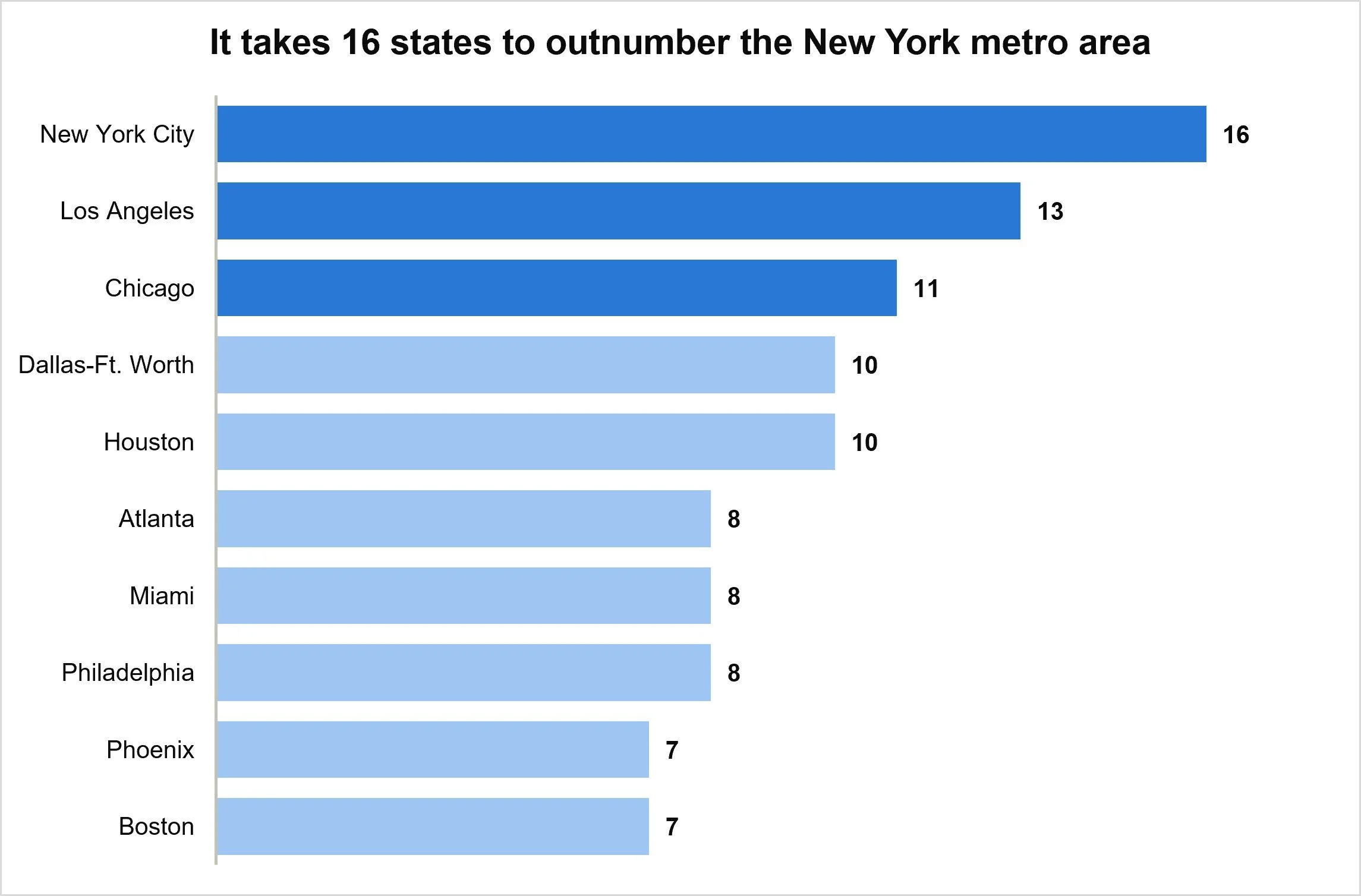
Under a pure national popular vote, a campaign could build its strategy around the largest states and metro areas and give little attention to everyone else. The presidential election is our only national election. Fairness in that election requires something like the Electoral College, a system that gives voters in less populous states a reason to believe their votes matter.
The changes I would make
Defending the Electoral College does not mean defending how it operates today. In 48 states and the District of Columbia, the candidate who wins the state takes all of its electoral votes. That rule is a state choice, not a constitutional requirement, and it treats a 50.1% win the same as an 80% win. Madison preferred another approach. In an 1823 letter to George Hay, he wrote that "the district mode was mostly, if not exclusively in view when the Constitution was framed & adopted."
I would make three changes:
The candidate receiving the most votes in a state receives the two electoral votes tied to its senators.
The state's House votes, are allocaterd by each candidate's share of the state's popular vote. The candidate receiving the most votes rounds up any fraction, no matter how small. Other candidates follow the same rule, in order of their vote totals, until all the votes are allocated.
The candidate with the most electoral votes wins, replacing the 270-vote majority requirement. The House of Representatives would decide the election only in the case of a tie.
Here is how the proposal works if Candidate A wins a state with 52% of the vote:
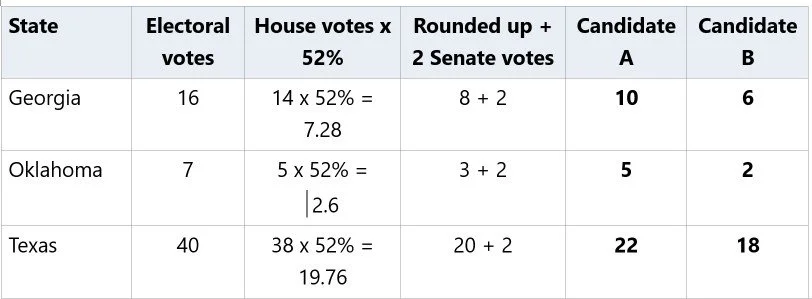
Under the current system, Candidate A would receive all 63 votes.
How would this have affected previous elections?
I applied this logic to every presidential election from 1976 through 2024, using state results from the MIT Election Data and Science Lab and federal results for 2024. None of the results would have changed.
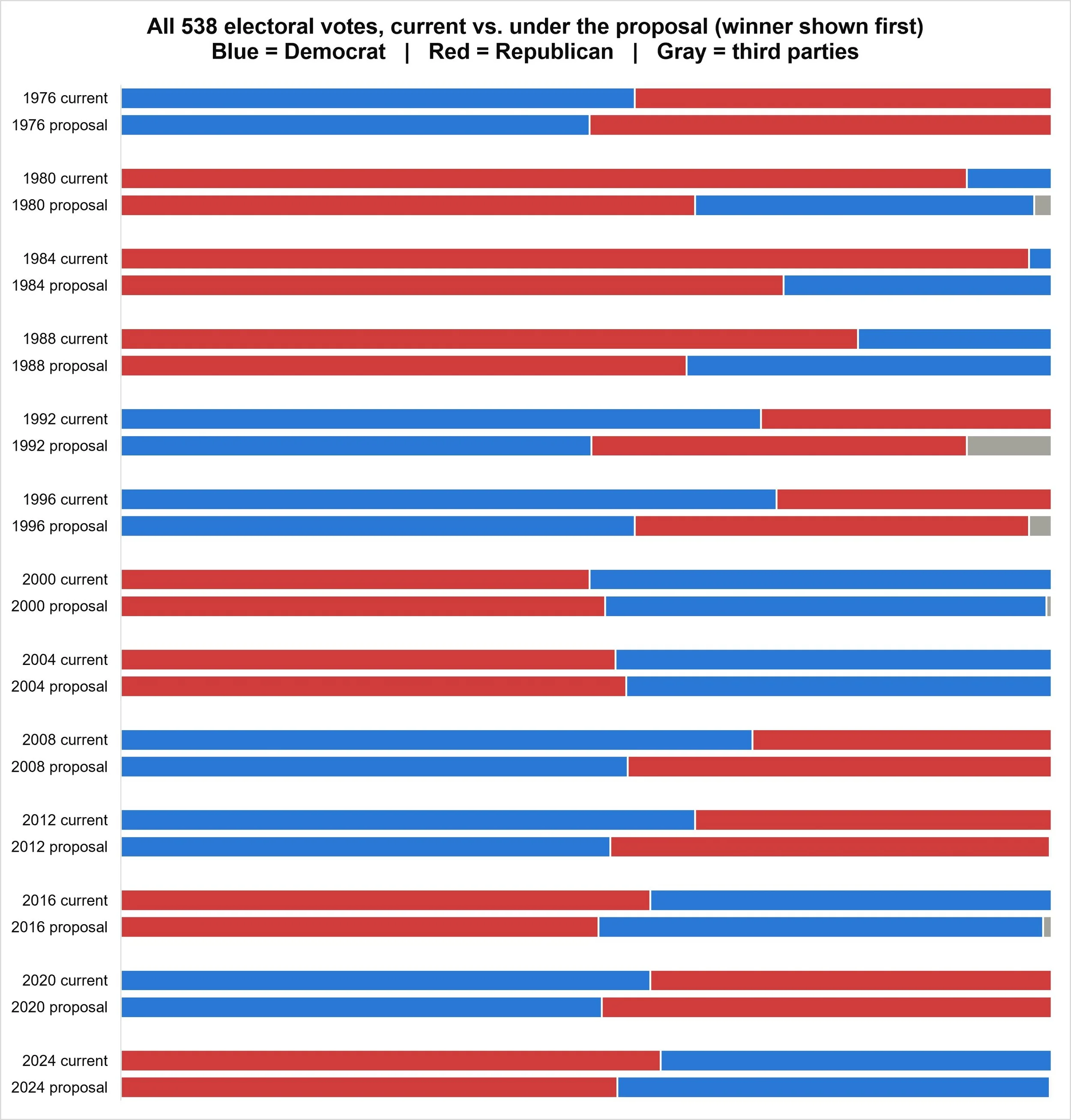
The margins of victory would have changed. In 11 of the 13 elections, the gap between the winner and the runner-up would have narrowed. Ronald Reagan's 1984 landslide would have dropped from 525 electoral votes to 383, and Barack Obama's 2008 total would have fallen from 365 to 293. The two exceptions were 2000 and 2004, when George W. Bush's margin would have grown. Third-party candidates would also have earned electoral votes, including 49 for Ross Perot in 1992.
Our only national referendum
If the results would not have changed, why make the change?
It would change how campaigns are run. Today, candidates rarely campaign in states they do not expect to win. Those voters see little of either party's nominee. Under this proposal, most states would have electoral votes in play. Candidates would have a reason to campaign in more places, meet more voters, and respond to more points of view.
How We Change Is Important
How we make the change matters as much as the change itself. A compact passed by one party, in states controlled by that party, would likely deepen the divisions we already feel. Amending the Constitution is slow and difficult by design, and that effort is useful. It forces us to listen to all stakeholders and build true consensus before we change the rules.
In my work with organizations at critical inflection points, the changes that last are the ones people help shape rather than the ones imposed on them. Our elections deserve the same care.
Every voice counts most when the map leaves no one out. Small states have voices.
Related articles
Farewell to the Electoral College? Democrats Now Control Enough States | PBS News
Conservatives Look to Protect Electoral College From Democrats | The Hill
Federalist No. 62: The Senate | The Avalon Project, Yale Law School
Federalist No. 68: The Mode of Electing the President | The Avalon Project, Yale Law School
Madison Debates, July 25, 1787 | The Avalon Project, Yale Law School
State Population Totals and Components of Change: 2020-2025 | U.S. Census Bureau
Metropolitan and Micropolitan Statistical Area Population Totals: 2020-2025 | U.S. Census Bureau
James Madison to George Hay, 23 August 1823 | Founders Online, National Archives
U.S. President 1976-2024 | MIT Election Data and Science Lab
Democrats' Midterm Gains Could Sideline Electoral College by 2028 | Axios
The Unconstitutional Compact to Nullify the Electoral College | Cato Institute
Chips And Salsa: Bite-Sized News and Posts
I use AI to help me write, NOT to write for me. That difference is crucial. (After all, no one tells us to not use Spell Check.)
Writers Distrust AI but Love Using It | Medium
Why I Believe I Lost My LinkedIn Top Voice Badge | LinkedIn
Life is good, and it is also hard. The best things in life are usually the ones we put the most effort into.
Never Let Them See You Sweat? Maybe That's the Problem | Yale Insights
Lucy is more enduring than we give her credit for.
This Far Side Peanuts Crossover Is Still Its Greatest Ever | Screen Rant
This is sad. We have the gift of being able to understand the world we live in, and failing to use what we are capable of is, in some ways, a sin.
Measles No Longer Eliminated in the U.S. | NBC News
This was an interesting article on how artworks are maintained.
Who Maintains MoMA's Masterpieces? | The New York Times
Time will tell whether Robert Pattinson will make a good James Bond. It's worth remembering that many objected to the casting of Daniel Craig.
Casino Royale 20 Years On | Fanfare
First impressions form quickly and resist change. This is especially true in our judgments of people.
Your First Impression Isn't the Whole Story | Philosophy Today
The Economy
Deficit spending is not sustainable at the federal, state, or local level. The problem will continue as long as so many elected officials run on platforms that promise lower taxes and more services.
States' Finances: Revenue and Expense Balance per Taxpayer | Statista
Neither party seems focused on the deficit. The main difference is who receives the tax breaks or payments.
Democrat Proposes $1,700 Refund Check for After Christmas | Newsweek
No wonder so many C-Suite executives have a bad reputation. They often prioritize decisions based on their rewards rather than all stakeholders.
These Companies Are Using Trump's Tariff Refunds for Executive Bonuses | ProPublica
Corporate Diplomacy: Stakeholder Value in Modern Business | Mark Rapier [Title taken from the link; please confirm against your article.]
Science and Technology
Chaos theory helped me learn how to look for overarching patterns in data.
Hidden Structures in Chaos | Science Spectrum
Chaos: Making a New Science | Amazon
I don't know how many of us will be around to see this, but it will be amazing.
Two Giant Black Holes in One Galaxy Could Merge in 100 Years | Space Daily
I would use AI for the second and third bullet seats. I cannot imagine a scenario where I would use it for points 1 and 4 because I believe those are where human judgment is most important.
4 Seats AI Can Occupy at the Negotiating Table | MIT Sloan
Quotes
"Honesty is often very hard. The truth is often painful. But the freedom it can bring is worth the trying."
Fred Rogers
"When you want to help people, you tell them the truth. When you want to help yourself, you tell them what they want to hear."
Thomas Sowell
"I suppose if we couldn't laugh at things that don't make sense, we couldn't react to a lot of life."
Bill Watterson
Join the Conversation
Subscribe on LinkedIn, Medium, or Substack.
Leadership is the most important work we do—in business and in life. I've spent over 40 years working with leaders across more than 100 companies, and I'm still learning. These newsletters share my thoughts on leadership today and what we can learn.
I need your help making this better. What topics hit home? What misses the mark? What leadership challenges are you wrestling with right now? Send them my way.
I use AI to enhance my writing. All of the ideas, recommendations, and opinions are mine. To read about my process for leveraging AI, please read this newsletter.
Find The Leader With A Thousand Faces and other recommended books on my website.