

PGA vs. LIV - A Leadership Retrospective
Saudi Arabia's Public Investment Fund (PIF) confirmed last week what golf insiders had suspected for months: they will end funding of LIV Golf after the 2026 season. A league that launched with multi-billion-dollar ambitions and a talent roster designed to rattle the establishment will close the chapter as a cautionary tale. A tale that has more to say about leadership than about golf.
This newsletter examines both sides of the rivalry. The PGA Tour was caught flat-footed. LIV Golf was never what it claimed to be. And the outcome, when viewed through a leadership lens, was probably more predictable than it seemed at the time.
The Early Years
LIV Golf launched in 2022 with a strategy built on financial shock and awe. The league, backed by Saudi Arabia's sovereign wealth fund, recruited aggressively, signing Phil Mickelson, Dustin Johnson, Brooks Koepka, Bryson DeChambeau, and Cameron Smith, among others. Guaranteed contracts, $30 million prize funds per event, and equity stakes in team franchises made the offers attractive.
The PGA Tour's initial response was blunt and arguably counterproductive. Commissioner Jay Monahan announced suspensions for any player who competed in a LIV event. Lifetime bans were threatened. LIV responded by suing the PGA Tour for antitrust violations, alleging unlawful monopoly power and restraint of trade. The PGA counter-sued. For two years, professional golf was overshadowed by courtroom drama.
Then came the twist no one anticipated. In June 2023, the PGA Tour and PIF announced a framework agreement to an eventual merger. Players were stunned and angry. Fans were confused. The Senate launched an investigation, and the Department of Justice took notice. Monahan acknowledged in a press conference that the framework was designed, in part, to take "the competitor off of the board" — a statement that antitrust scholars described as precisely what you should never say publicly about a merger. Total PIF investment in LIV is estimated to have exceeded $5 billion and is projected to surpass $6 billion by the end of the 2026 season.
PGA Assessment: Slow Strategy Was the Right Strategy
The formation of LIV caught the PGA Tour by surprise. It should not have. Player frustrations about purse distribution, scheduling demands, and limited financial security for mid-tier players were widely discussed. When an organization waits for a competitor to exploit its internal grievances, leadership has already made a costly error. The warning signs were there; the PGA Tour did not act on them.
When LIV arrived, Monahan's initial response was reactive. Lifetime suspension threats read more like panic than strategy. Criticism of Monahan's later decision to enter merger talks deserves closer scrutiny. In the middle of active antitrust litigation, PIF, with effectively unlimited resources, presented a credible threat to the tour's financial survival. Negotiating slowly, while never reaching a definitive agreement, proved to be the correct approach. The framework expired. The litigation was neutralized.
The strategy of patience, choosing to move deliberately, allowed the PGA Tour to defuse the legal threat without surrendering control. It is questionable whether Monahan designed it that way from the start. More likely, the patient approach evolved. In this respect, the outcome was fortunate. The result is the same: the tour outlasted the challenge. That is worth acknowledging, even by those who found the merger announcement jarring.
LIV Assessment: Sportwashing Has Its Limits
LIV Golf was always a more complicated proposition than a simple sports league. PIF's investment in golf was part of a broader Saudi strategy to reposition the kingdom's international image through sports; a practice critics called sportswashing. The return on investment was never purely financial. That latitude allowed LIV to operate as a startup at investment fund scale, absorbing losses that would have ended more conventional sports ventures.
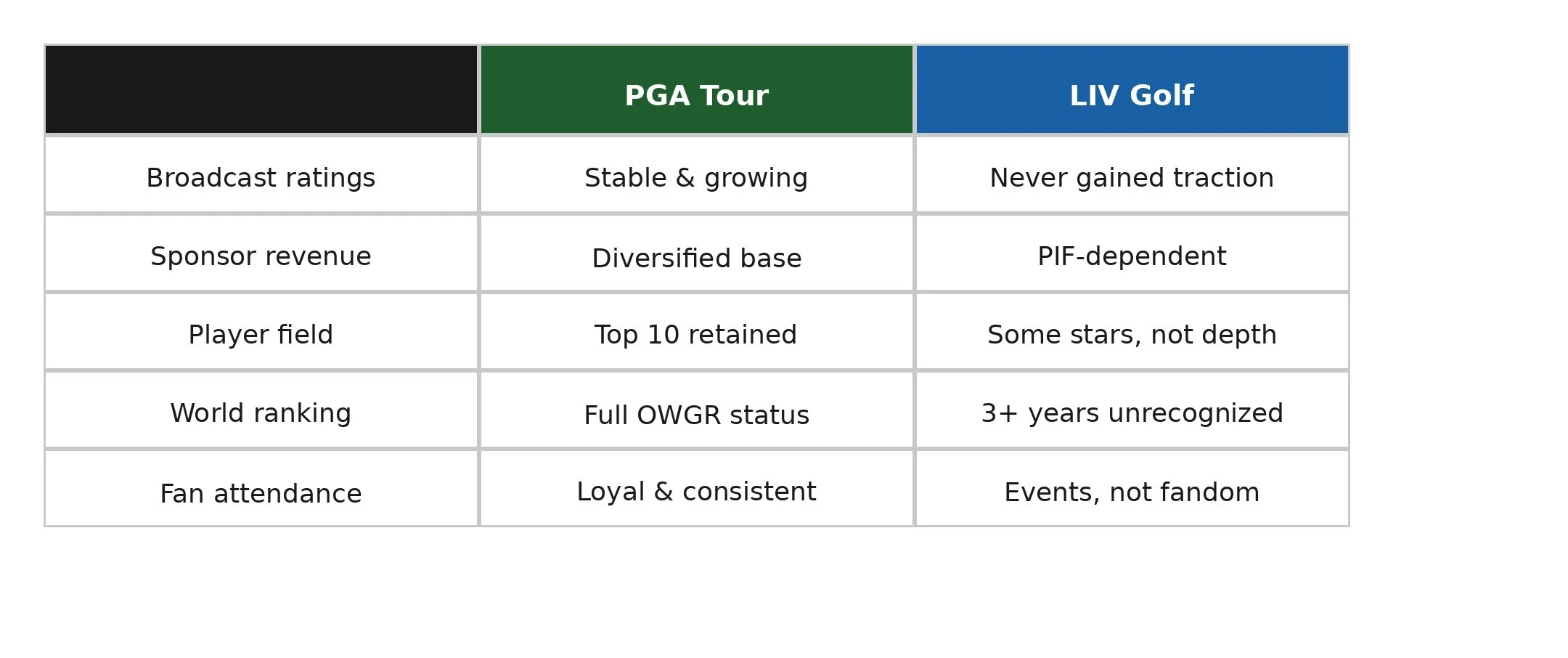
The long-term problem was that LIV never built a product people wanted to watch. Fan interest was always marginal. Television ratings lagged well behind PGA Tour coverage and many events were untelevised. Broadcast deals never delivered the audience numbers needed to attract major sponsors. The team format, LIV's signature innovation, took more than three years to earn recognition from the Official World Golf Ranking, creating a credibility gap.
In the end, even a sovereign wealth fund answers to investment priorities. When PIF tightened its balance sheet, driven in part by regional geopolitical pressures and a broader shift toward domestic Saudi projects, LIV lost its support. A product that never achieved legitimacy with the majority of professional golfers, the media, or the public had no foundation to stand on.
Unfinished Business
The PGA Tour has entered into a moment of relative calm. The underlying vulnerabilities that made LIV possible have not disappeared. Players at the middle of the earnings distribution still face financial uncertainty that has no equivalent in other major professional sports. A next breakaway league, better organized and with a clearer business model, could exploit those same pressure points. The tour's work is not finished.
With LIV fading from the picture, the tour has an opportunity to focus on what matters most: the players and the fans. That means revisiting purse structures, improving the competitive calendar, and investing seriously in audience development. Building the next generation of viewers requires deliberate effort.
There is one reform worth advocating: a more formal and transparent promotion-and-relegation structure linking the PGA Tour, the Korn Ferry Tour, the regional tours, and qualifying schools. The sport already has the scaffolding; the missing piece is transparency. Promotion and relegation are common discussions among European football fans. That kind of structural clarity in golf would benefit players, fans, and the long-term health of professional golf. Challenges do not resolve themselves — they require organizations to change before a crisis forces the issue.
The rival is gone. The gallery never filled. Patience won the day.
Related articles
LIV Golf is dying. The damage is permanent | Yahoo!Sports
LIV Golf changed the PGA Tour — but not for the better | Golf
Can LIV Golf Survive Without The Saudi PIF? | Golf Monthly
Bryson DeChambeau Breaks Silence on LIV Golf Future as PIF Cuts Funding | Essentially Sports
‘Don’t know what’s going to happen’: PGA Tour players react to LIV news | Golf
What's next for LIV Golf after losing Saudi funding | NPR
PGA Tour countersues LIV Golf in escalating antitrust fight | CNBC
Why now? Commissioner Jay Monahan says money, competition led to LIV alliance | CNBC
Chips And Salsa: Bite-Sized News and Posts
An interesting list of 'Stories You May Have Missed.'
Six-Chart Sunday – Six Important Stories You May Have Missed | Bruce Mehlman's Age of Disruption
A story of uncommon Bravery. If you are in Arlington, Texas, the Medal of Honor Museum is a must see.
Leaders Leave Last: The Story of Christopher Celiz | National Medal of Honor Museum
I always enjoy Daniel Parris's analysis. This one overlooks one reality. The music we listen to today from the 50s, 60s, and 70s is the best of the era. The slop has long since been forgotten. In a few decades, the same will be true for today's music.
Has New Music Become Less Popular? | Stat Significant
Think in quarters, not decades.
How a Long-Term Perspective Helps Leaders Navigate Uncertainty | Inc.
Not much worse than unforced errors.
'Worth a thousand words': Trump photo obscuring women's tennis team sparks backlash | The Guardian
Never stop reading. It leads to understanding.
Does reading do us any good? | Aeon
A Penguin Slips on a Banana
The Far Side's 20 Greatest Wordless Comics of All Time | CBR
Some Science Posts
This reminds me of the premise of Hulu's Paradise.
What would happen if Yellowstone's 'supervolcano' erupted today? | Popular Science
Mysteries of the deep.
Mysterious "golden orb" found in ocean depths off Alaska in 2023 is finally identified | CBS News
People were creating long before science caught up with what they were building.
Many complex structures predate the scientific method. How? | Aeon
Quotes
"Children who have not been taught to confront challenges will try to avoid all challenges."
Alfred Adler
"Be less curious about people and more curious about ideas."
Marie Curie
"To be yourself in a world that is constantly trying to make you something else is the greatest accomplishment."
Ralph Waldo Emerson
Join the Conversation
Subscribe on LinkedIn, Medium, or Substack.
Leadership is the most important work we do—in business and in life. I've spent over 40 years working with leaders across more than 100 companies, and I'm still learning. These newsletters share my thoughts on leadership today and what we can learn.
I need your help making this better. What topics hit home? What misses the mark? What leadership challenges are you wrestling with right now? Send them my way.
Find The Leader With A Thousand Faces and other recommended books on my website.