

What History Teaches About The Decisions We Cannot Undo

Photo by Virgil Cayasa on Unsplash
I read a lot of history. The past does not repeat with any precision, but because it reveals patterns worth studying, including stories of leaders who could not see that the world they were managing had already become something different.
The recent ceasefire between the United States, Israel, and Iran is welcome. Whatever led to it and whatever follows, a pause in the fighting matters. But a ceasefire is not a conclusion. It is a moment to ask a harder question: How did we get here, and what does the answer tell us about how we make decisions when the stakes are high and the future is unclear?
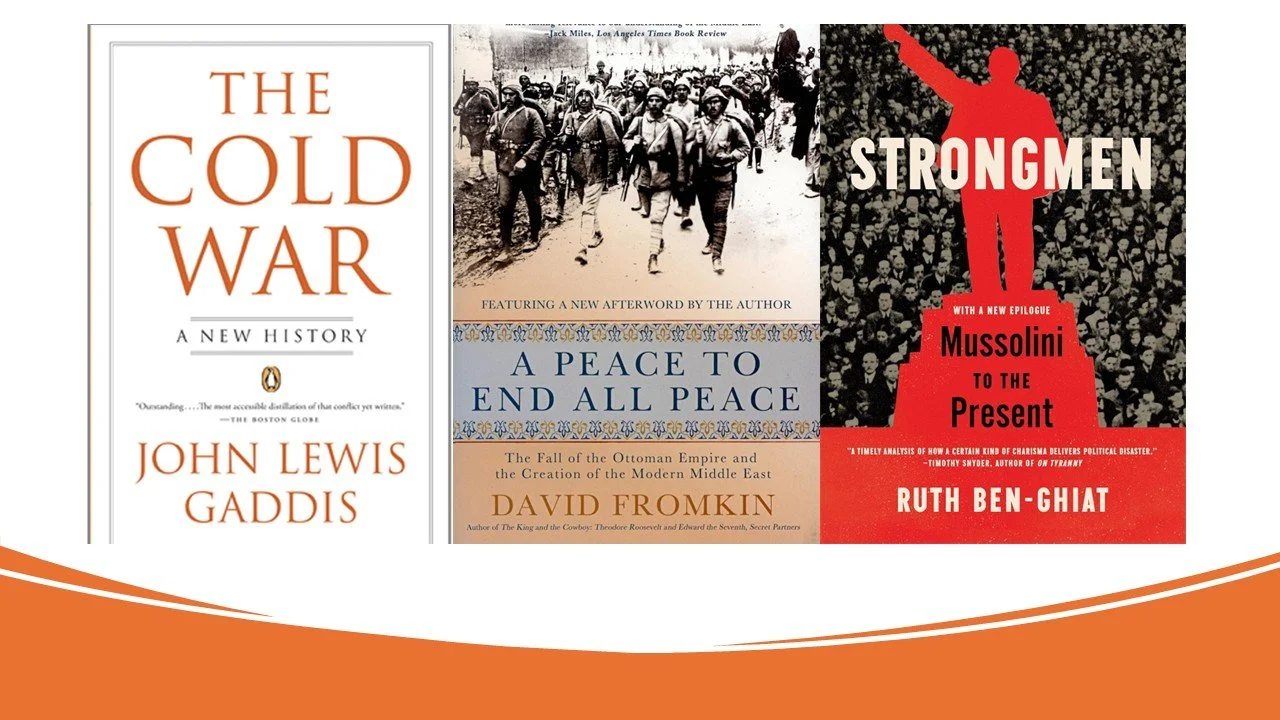
A few days ago, I finished John Lewis Gaddis's The Cold War: A New History. The book covers far more than the rivalry between the United States and the Soviet Union. It traces the long-term downstream effects of decisions that seemed reasonable in the moment but proved problematic over time. That is the lesson I am returning to.
The Decisions We Cannot Fully See at the Time
In the early 1950s, the United States supported the coup that removed Iran's democratically elected prime minister and returned the Shah to power. The reasoning was strategic and, in its own terms, logical: the Shah was reliably anti-Soviet, the oil supply remained stable, and Iran seemed manageable. It was a decision optimized for the present.
Whether there is a direct causal line between that decision and the Islamic Republic that emerged in 1979 is a question historians still debate. The relationship between the 1953 coup, the grievances it generated, and the revolution that followed is tangled and complex, with many other forces at work across those twenty-five years. What is harder to dispute is that decisions made with short-term logic can create conditions that play out over decades in ways no one anticipated. The Shah was a repressive leader whose regime accumulated resentments among Iranians. When it collapsed, those resentments shaped what came next. That is not a simple cause-and-effect story, but it is a story about consequences arriving long after the decision that set them in motion.
David Fromkin's The Peace to End All Peace adds another layer. The borders drawn across the Middle East after World War I were the work of British and French diplomats, in support of their colonial priorities, not based on any knowledge of the cultural and religious geography they were carving up. Those borders did not create all the tensions that exist today, but they established conditions that made stable governance exceptionally difficult. Ruth Ben-Ghiat traced one consequence in Strongmen: Mussolini to the Present was the way those conditions became incubators for authoritarian rule across the region.
The throughline in these examples is not that the decision-makers were foolish. They were not. They were solving the problem in front of them with the tools and assumptions they had. The problem is that they did not, and perhaps could not, see how far the consequences would play out.
The Same Pattern in Business
The history of business has many examples of the same dynamic.
Kodak engineers invented the digital camera in 1975 and brought it to management. The decision to hold back was rational by metrics available at the time: digital threatened the film business, the film business was profitable, and the market for digital photography was entirely theoretical. Protect what works. The logic was sound. The failure was in the leadership's inability to see the potential.
Xerox PARC developed the graphical user interface and the computer mouse in the early 1970s. The people who built those technologies understood what they had created. The leaders who received their reports chose to stay focused on copy machines. They were not indifferent to innovation. They were managing a profitable business with a clear competitive advantage. They did not see that the world was about to reorganize itself around personal computing.
BlackBerry held the dominant position in the smartphone market as late as 2007. When the iPhone arrived, BlackBerry's leadership assessed the threat and concluded that enterprise customers would not accept a phone without a physical keyboard. They were describing their current customers accurately. They did not see how the market was changing around them.
In each case, the leaders involved were not asleep. They were managing well within the frameworks they had. The frameworks had stopped matching the world, and they did not see it. When leaders sit in the C-suite and on Boards, they are responsible for seeing inflection points. These were leadership failures.
The Harder Question
We tend to frame these cases as failures of courage or vision. That framing is too simple. What they share is something more structural: an absence of systems for recognizing when the rules have changed. The organizations had processes for managing what already existed. They did not have processes for asking whether what already existed was still the right thing to manage.
Uncertainty is the permanent condition of leadership. The question is whether we have built the capacity to distinguish between the uncertainty that calls for patience and the uncertainty that signals that the ground has shifted and something genuinely different is required. That distinction, made at the right moment, is one of the most consequential things a leader does. History will reveal whether we got it right.
The ceasefire is a beginning, not an end. The decisions that follow it will carry consequences that none of us will fully understand for years. That is not a reason for paralysis. It is a reason to approach those decisions with the kind of systematic thinking that takes the long view and builds organizations that can act with confidence in the face of change.
The rules changed at dawn, we managed for yesterday, history keeps score.
Related articles
The Big Thing: We Are In A World War That Isn't Going To End Anytime Soon | Ray Dalio
America Has Lost the Arab World | Foreign Affairs
How will the Iran war change the Middle East? We asked 5 experts | The Conversation
World exhales — a little — as US, Iran agree to ceasefire | Politico
It Will Take Months to Get Oil and Gas Flowing out of the Persian Gulf | The New York Times
Oil passed $100 a barrel, with prices expected to keep rising | Marketplace
Chips And Salsa: Bite-Sized News and Posts
Sometimes movies inspire life.
An Eddie Murphy comedy shaped insider trading law for prediction markets | Marketplace
I remember my times at Dobie Mall. Eating Schlotzsky's before franchising ruined the sandwiches. Marginal midnight movies with lots of audience participation. My memories predate the authors by at least a decade.
This once beloved Texas mall is a shell of its former glory | MYSA.com
This article makes a common mistake; it confuses management with leadership.
Why Everything We Know About Management Is Wrong | Forbes
There are times when the desire to be eloquent is the enemy of clarity.
This no-nonsense judge is working to resolve Trump's $165 billion tariff mess | MSNow
Making predictions is a risky business.
Six-Chart Sunday – Nobody Knows Nuthin’ (Spring 2026) | Bruce Mehlman's Age of Disruption
Science Fiction is much better than Science Fantasy or Comic Book films.
Forbidden Planet: 70 Years On | Medium
Some History
Baseball, Broadcasting, & Compact Cars: Forgotten Mr. Crosley | American History Business Center
When France Was Liberated, Men Shaved Women's Heads in the Streets | Medium
THE MANY LIVES OF EDWARD RICKENBACKER | The National Medal of Honor Museum
Some Science
How the solar wind really works | Phys.org
Quotes
"No generation can escape history."
George H.W. Bush
"There's an old saying about those who forget history. I don't remember it, but it's good."
Stephen Colbert
"Those who cannot remember the past are condemned to repeat it."
George Santayana
Join the Conversation
Subscribe on LinkedIn, Medium, or Substack.
Leadership is the most important work we do—in business and in life. I've spent over 40 years working with leaders across more than 100 companies, and I'm still learning. These newsletters share my thoughts on leadership today and what we can learn.
I need your help making this better. What topics hit home? What misses the mark? What leadership challenges are you wrestling with right now? Send them my way.
Find The Leader With A Thousand Faces and other recommended books on my website.