

Image created by Nano Banana
Can You Take UsInto Your Brain?
A reporter put that question to Eileen Gu at the 2022 Winter Olympics, and her answer was nothing like we expected. She did not talk about natural ability or the mechanics of a jump, or the hours logged on the slope. She talked about how she manages her thinking, describing it with the same precision and seriousness she brings to her sport.
Gu explained that she trains her mind the way she trains her body: deliberately, consistently, and with a clear understanding of what she is building. She has learned to identify which thoughts serve her success and which ones undermine it, and she has practiced this mode of thinking until it has become a reflex. This is not The Power of Positive Thinking in the motivational-poster sense. It is a discipline built through repetition; it is the foundation for how she processes pressure, setbacks, and high-stakes moments.
What she described is neuroplasticity in practice: the brain's demonstrated ability to reorganize itself based on what we repeatedly do. Neural pathways that get used grow stronger. Pathways that go unused weaken. This means that the way we habitually respond to difficulty, whether we default to anxiety or steadiness, to self-criticism or self-correction, is not fixed at birth. It is shaped through practice. Gu has taken that principle seriously in a way that most people, including most leaders, have not yet done.
Two Silvers Gained or Two Golds Lost?
The second interview moment shows you the training in action. A reporter asked Gu whether she viewed her two silver medals as two silvers gained or two golds lost. The question had an edge. It positioned her at the border of achievement and disappointment and invited her to step to one side or the other.
She rejected the question's binary nature. She processed the question in real time, rejected the frame it offered, and replaced it with one that was both honest and productive. Gu competes at the highest level in her sport and is the most decorated athlete in the sport. Competing in the Olympics confirms her standing among the best in her craft. She embraced winning Silver just as much as Gold. That is not spin or avoidance. That is what it looks like when someone has trained their brain to reframe under pressure rather than simply react.
The contrast with how most of us handle similar questions is worth thinking about. How often does a difficult quarter, a deal that falls through, or a project that underdelivers become the story we tell ourselves for the next six months? The event happened. The meaning we assigned it is our own construction. Gu's discipline is the recognition that we have far more control over that construction than most of us exercise.
Watch both interviews in the links below. The first gives you Gu's framework for how she approaches the mind. The second shows that framework operating in real time, under the pressure of a pointed question with no time to prepare. Together, they make a stronger case for intentional brain training than most books on the subject, including the ones I have been reading lately.
What the Research Confirms
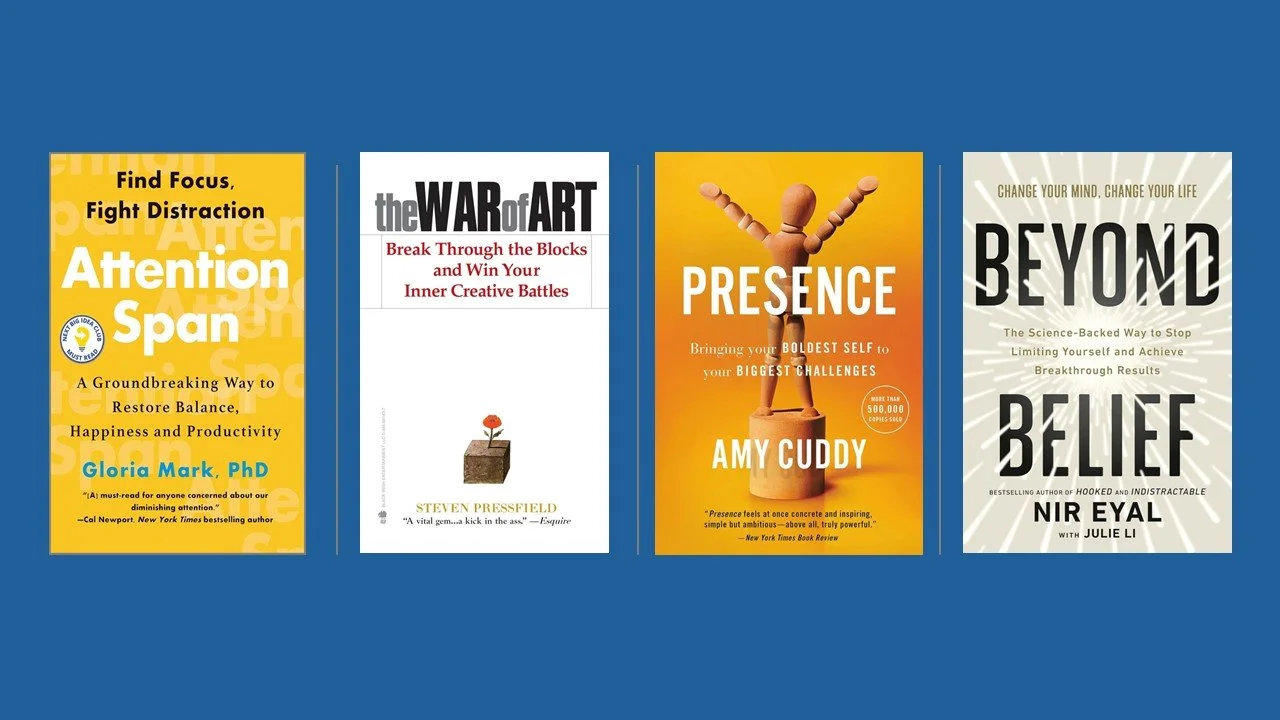
Three books I have read each arrive at the same place from a different direction. Steven Pressfield in The War of Art draws the line between professionals and amateurs at exactly this point: professionals do not allow outside events to determine their inner state, while amateurs are defined by what happens to them. Gloria Mark's Attention Span adds the cognitive science layer, documenting that our mental resources are finite and depletable, that distraction and multitasking erode the reserves we need for clear judgment, and that we each have daily rhythms of peak capacity that most of us ignore entirely. Amy Cuddy's Presence connects the physical and the mental, showing that the internal states we cultivate through deliberate practice shape how we show up before we say a word.
The soon to be released Beyond Belief by Nir Eyal and Julie Li will extend the discussion into the mechanics of belief itself: what we repeatedly tell ourselves about our own capacity becomes a self-reinforcing structure in the brain. Each of these writers, from different vantage points, describes the same phenomenon: Eileen Gu practicing on the slopes. The mind is not a fixed instrument. It responds to how we train it.
This Is An Essential Skill Leaders Need
Leadership creates conditions that expose exactly this gap. The pressure is real. The information is incomplete. The decisions carry weight. And the instinct to react quickly, to protect position, to assign blame, to treat the first interpretation as the correct one, is always present and always loudest at the moments that matter most.
The leaders who perform well across time are not the ones with the sharpest instincts. They are the ones who have learned to work with their instincts rather than surrender to them. Something happens, and before acting on it, they stop. They ask what actually occurred, stripped of the interpretation that arrived with it. They ask whether the instinct is signal or noise, whether the reaction serves the situation or only the ego. They reframe the event. They choose a response. That sequence, practiced enough times, becomes its own reflex, one that operates quickly and reliably even when the stakes are highest.
This is where neuroplasticity becomes a leadership issue rather than a textbook footnote. The capacity to pause before reacting, to reframe under pressure, to select a response that fits the moment rather than just the impulse: these are trainable capacities. They are not personality traits distributed unevenly at birth. They are skills developed through the same mechanism that all skills develop through: deliberate practice, sustained over time.
The most consequential moments in any leader's career are the ones where the path forward is genuinely unclear. The familiar approach no longer fits, and the organization is watching to see how its leader processes uncertainty. Those moments demand the ability to see the situation clearly, to resist the pull of the first interpretation, and to make a decision deliberately rather than default to the first impulse. That ability is not available on demand without preparation. It is built in the quieter moments, through exactly the kind of consistent, intentional practice that Eileen Gu brings to the slope every day. The question worth asking is whether we are building it.
As events unfold
Instinct emerges, how we
React is a choice
Author's Note: Conversations surround Eileen Gu and her decision to represent China in international competitions. I have not seen any articles in which she explains her position. I have included a recent article on this topic.
Related articles
Eileen Gu: Can you take us into your brain? | YouTube
Eileen Gu: Silvers Won or Golds Lost
Gen Z Olympic champion Eileen Gu says she rewires her brain daily to be more successful | Fortune
Brain development may continue into your 30s, new research shows | Science News
How Does Neuroleadership Enhance Executive Decision-Making and Performance? | Mark Selliott
Training Leaders to Build New Neural Pathways for Change | Training Industry
In Alysa Liu and Eileen Gu, China and America See a Mirror Image | The New York Times
Chips And Salsa: Bite-Sized News and Posts
I particularly like number 6 – Don't "optimize the life out of your life."
Six-Chart Sunday – Rational Optimism | Bruce Mehlman's Age of Disruption
Friction in the right places improves outcomes. Too much friction and things grind to a halt.
Can 'friction-maxxing' fix your focus? | BBC
It seems that each new piece of news is designed to increase my feeling that the economy is fragile.
February jobs numbers worse than expected, especially in health care | Marketplace
The Economy Looks Strong; Why Does It Feel Fragile? | Mark Rapier
Heroes are made by circumstance. They are not born. They are the result of all of the events in their lives. The circumstance comes when something happens, and the opportunity to step up presents itself.
Mars Attacks! is one of my favorite movies. Another film in the absurdist parody genre worth watching is John Waters's Cry Baby.
Mars Attacks! (1996) • 30 Years Later —Tim Burton's gleeful exercise in nihilism | Medium
It is important to plan career pivots. Waiting for circumstances to force a change rarely works out.
3 Signs It's Time for Your Next Chapter | KelloggInsight
A few science and technology articles
Here's why sneakers squeak on the basketball court | ScienceNews
NASA changed an asteroid's orbit around the sun for the first time | NewScientist
Quotes
"The really unhappy person is the one who leaves undone what they can do and starts doing what they don't understand."
Johann Wolfgang von Goethe
"I am not what happened to me, I am what I choose to become."
Carl Jung
"We lose ourselves in the things we love. We find ourselves there, too."
Kristin Martz
Join the Conversation
Subscribe on LinkedIn, Medium, or Substack.
Leadership is the most important work we do—in business and in life. I've spent over 40 years working with leaders across more than 100 companies, and I'm still learning. These newsletters share my thoughts on leadership today and what we can learn.
I need your help making this better. What topics hit home? What misses the mark? What leadership challenges are you wrestling with right now? Send them my way.
Find The Leader With A Thousand Faces and other recommended books on my website.