
From Outcry to Acceptance: The Evolution of Digital Surveillance
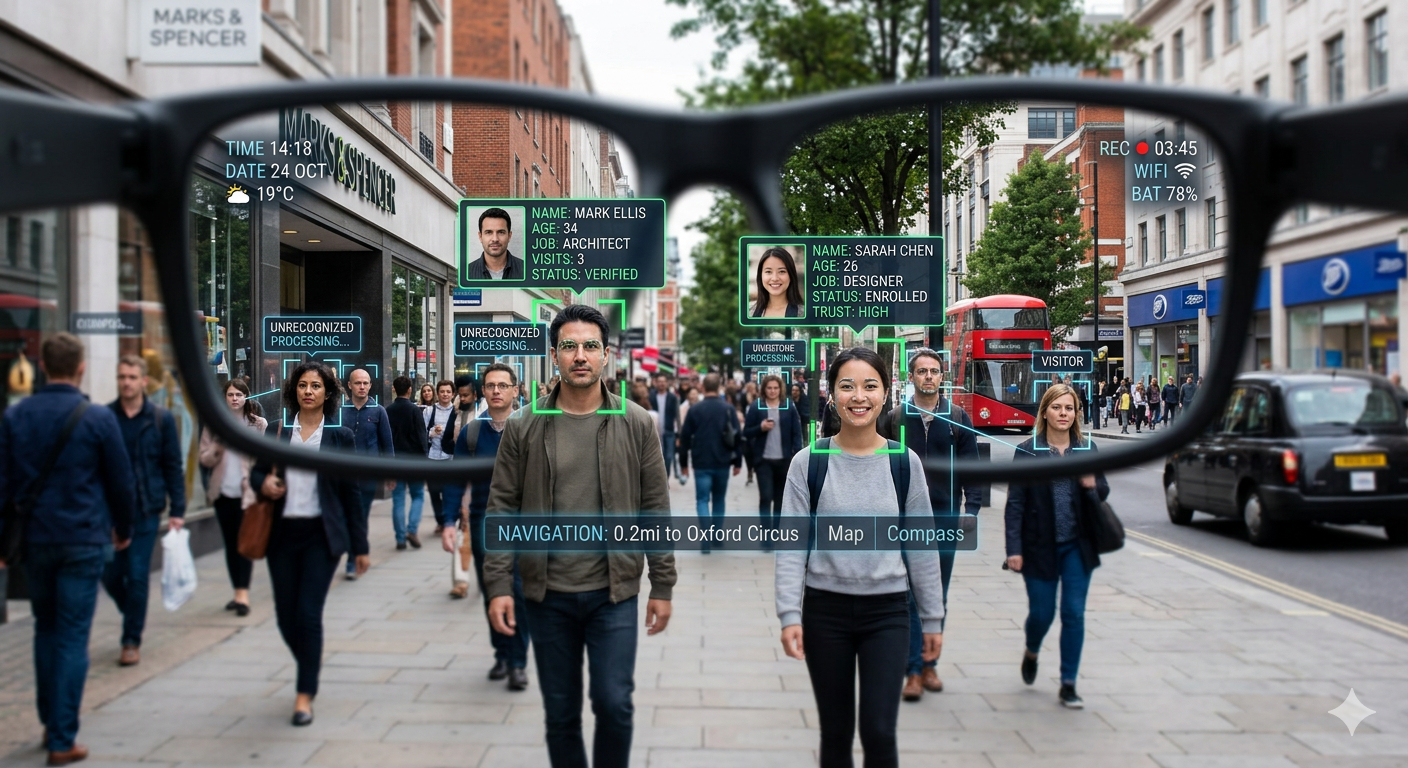
Image created by Nano Banana
The Erosion of Our Digital Boundaries
In 2013, Google launched Google Glass, sparking immediate outcry over privacy concerns. People saw the camera. They understood what it meant. They pushed back hard. Restaurants banned it. Lawmakers asked questions. The backlash was swift enough, and Google quietly shelved the project within two years. The public's instinct was right: a camera on your face changes the social contract.
A decade later, Meta released its AI glasses, yet we see comparatively little pushback. This shift in public sentiment suggests we have traded our vigilance for convenience. Meta's Ray-Ban AI glasses are much less obvious than the original Google Glass. Because they look like regular Ray-Bans, it is easier for people to record others without them ever realizing it.
AI glasses are not the only example.
The Note-Taker in the Room
My inbox is full of ads for AI-powered digital note takers. These devices attach to a phone or sit on a desk, recording every word of every meeting and phone call. They promise to free your attention, summarize the conversation, flag action items, and transcribe every speaker. The convenience case is real. The need for consent is never mentioned.
In the United States, eleven states require two-party consent. All participants must agree before a conversation can be recorded. The remaining states require only one party consent, which typically means the person doing the recording. Europe applies the stricter two-party standard under GDPR. When your meeting includes participants from multiple states, the safest legal assumption is that the strictest rule applies.
There are also data security concerns. Protecting proprietary information and intellectual property can be put at risk. All of the note takers send the recordings to their cloud infrastructure for AI analysis. When this happens, control of the data is lost.
What Do We Lose With Automated Note-Takers
The purpose of taking notes has never been to capture every word. It is to understand what matters and why. Notes force engagement: you have to listen, interpret, and decide what is worth recording. That act of synthesis is where comprehension happens.
When a device records everything, that cognitive work disappears. The transcript exists, but the understanding may not. Research on learning suggests that writing, even imperfect, incomplete writing. encodes memory in ways that passive recording does not. The note-taker that promises to set you free may, in practice, lead you to stop paying attention. That is probably not the outcome anyone intended.
What Transparency Actually Looks Like
Protecting privacy is not complicated. It requires two things: transparency and consent. Before using any recording or AI transcription tool, ask every participant directly. Not through a terms-of-service checkbox buried three clicks deep. Ask them out loud. If anyone declines, do not use the tool. That is the standard—and it is not a very high bar.
Privacy, once lost
It is lost forever, so
Always be on guard
Related articles
Smart Glasses Are Back, Privacy Issues Included | Help Net Security
Meta Plans to Add Facial Recognition Technology to Its Smart Glasses | The New York Times
Regulator contacts Meta over workers watching intimate AI glasses videos | BBC
It's Okay to Say No to AI Notetaking and Meeting Recordings | Coblentz Patch Duffy & Bass LLP
Why Google Glass Failed: Price, Privacy, and Tech Limitations | Investopedia
Google Glass - a fascinating failure? | BBC
Notes Aren't for Remembering. They're for Seeing. | Medium
Why Writing by Hand Is Better for Memory and Learning | Scientific American
Chips And Salsa: Bite-Sized News and Posts
To avoid turning our brains into mush, we have to learn to use AI effectively.
Two more articles that reinforce my feeling that the economy is in a fragile state. I added a link to this topic in my newsletter; it was written before the Iran War.
It All Comes Down to Who Controls the Strait of Hormuz: The “Final Battle" | Ray Dalio
The Economy Looks Strong; Why Does It Feel Fragile? | Mark Rapier
Understanding cultural differences requires looking beyond the obvious.
The Far Side was always funny. I like number 9.
10 Wordless The Far Side Comics That Are Basically Perfect | Screen Rant
Our business landscape is changing rapidly. One question to ponder: When does a mid-sized city, become large?
Americans Heading to Mid-sized Cities in the 21st Century | American Business History Center
If you see someone struggling, face it head-on, no matter how uncomfortable it may be. Choosing denial is an enabling behavior.
A Eulogy for My Ex-Wife | Medium
In many ways, I found Six Sigma to be overhyped. One takeaway I still use is planning for three alternatives – best case, worst case, and likely case. Document what would have to happen for the risks, issues, dependencies, and assumptions for each. This gives you the information you need to take advantage of opportunities and avoid pitfalls.
The Pre-Mortem: The Most Underrated Leadership Tool You’re Probably Not Using | Medium
Science Articles
An Unexpected Planetary Neighbor May Play a Surprising Role in Earth’s Climate Cycles | SciTechDaily
Quotes
“Live in such a way that you would not be ashamed to sell your parrot to the town gossip.”
Will Rogers
“You can’t use reason to convince anyone out of an argument that they didn’t use reason to get into.”
Neil deGrasse Tyson
“We should treat personal electronic data with the same care and respect as weapons-grade plutonium – it is dangerous, long-lasting and once it has leaked there's no getting it back.”
Corey Doctorow
Join the Conversation
Subscribe on LinkedIn, Medium, or Substack.
Leadership is the most important work we do—in business and in life. I've spent over 40 years working with leaders across more than 100 companies, and I'm still learning. These newsletters share my thoughts on leadership today and what we can learn.
I need your help making this better. What topics hit home? What misses the mark? What leadership challenges are you wrestling with right now? Send them my way.
Find The Leader With A Thousand Faces and other recommended books on my website.