
Beyond the Unthinkable: Strategic Planning for Existential Threats

Photo by Dave Photoz on Unsplash
Leadership demands that we prepare for challenges we hope never to face. Among the most difficult are existential risks. The kinds of threats that could fundamentally reshape or even end our organizations. These fall into two categories: black swans and gray rhinos.
Black swans are those truly unforeseeable events, appearing without warning from completely unexpected directions. But gray rhinos? The term, coined by Michele Wucker, describes risks that are visible, probable, and impactful—yet often ignored until they charge. (The Gray Rhino: How to Recognize and Act on the Obvious Dangers We Ignore)
China’s Demographic Challenge
China faces a declining population, which will have profound implications for its ability to sustain GDP growth. Despite government programs encouraging higher birth rates, success has been limited. The current demographic crisis is an unintended consequence of the one-child policy launched in 1979. Though the policy shifted to allow two children in 2016 and three in 2021, the cultural and economic factors suppressing birth rates have proven resistant to policy changes.
What This Might Mean for Business Today
For global business leaders, China’s demographic decline creates multiple scenarios that could affect us. Here are two.
Scenario One: Economic Contraction
If China’s GDP shrinks as its population ages and declines, what happens to your global planning? How will customer markets shift? What becomes of offshore manufacturing dependencies? What will supply chain trends look like? If we wait for the crisis to arrive, our options will be limited and not very good.
Scenario Two: Taiwan
Alternatively, what if China seeks to absorb Taiwan’s GDP through invasion? The Chinese government has long claimed Taiwan as a Chinese province. Over the last few years, they have held many military exercises in the area. How long might such a conflict last? How many countries would become involved? What would be the regional and global economic repercussions? Each scenario requires fundamentally different preparation.
A Process for Addressing These Risks: Create Your Own Risk Matrix
The key to managing existential threats is systematic preparation:
Build a Risk Matrix
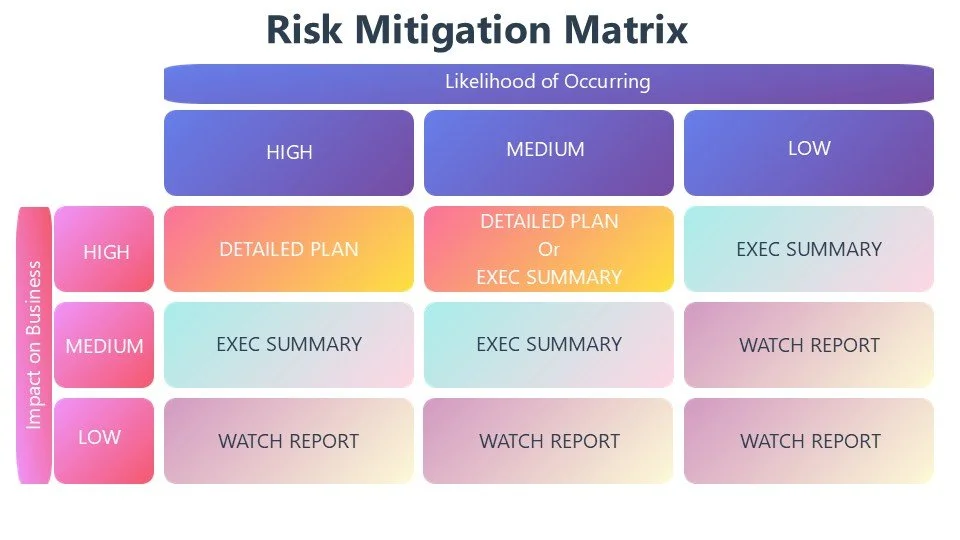
Chart each potential risk by impact on your business and likelihood of occurrence. This visualization helps prioritize where to focus your planning efforts.
Take One of Three Actions
Based on your matrix positioning:
High probability/high impact: Build detailed response plans so you can act quickly when needed
Medium risks: Write comprehensive executive summaries that can be quickly turned into plans
Emerging risks: Develop “Watch Reports” that track key indicators
Review Regularly
Establish a cadence to revisit your risk matrix. Risks change. Some will fade away. New ones will arise. Yesterday’s watch item might be tomorrow’s crisis. Regular review ensures you elevate or lower risks based on changing conditions.
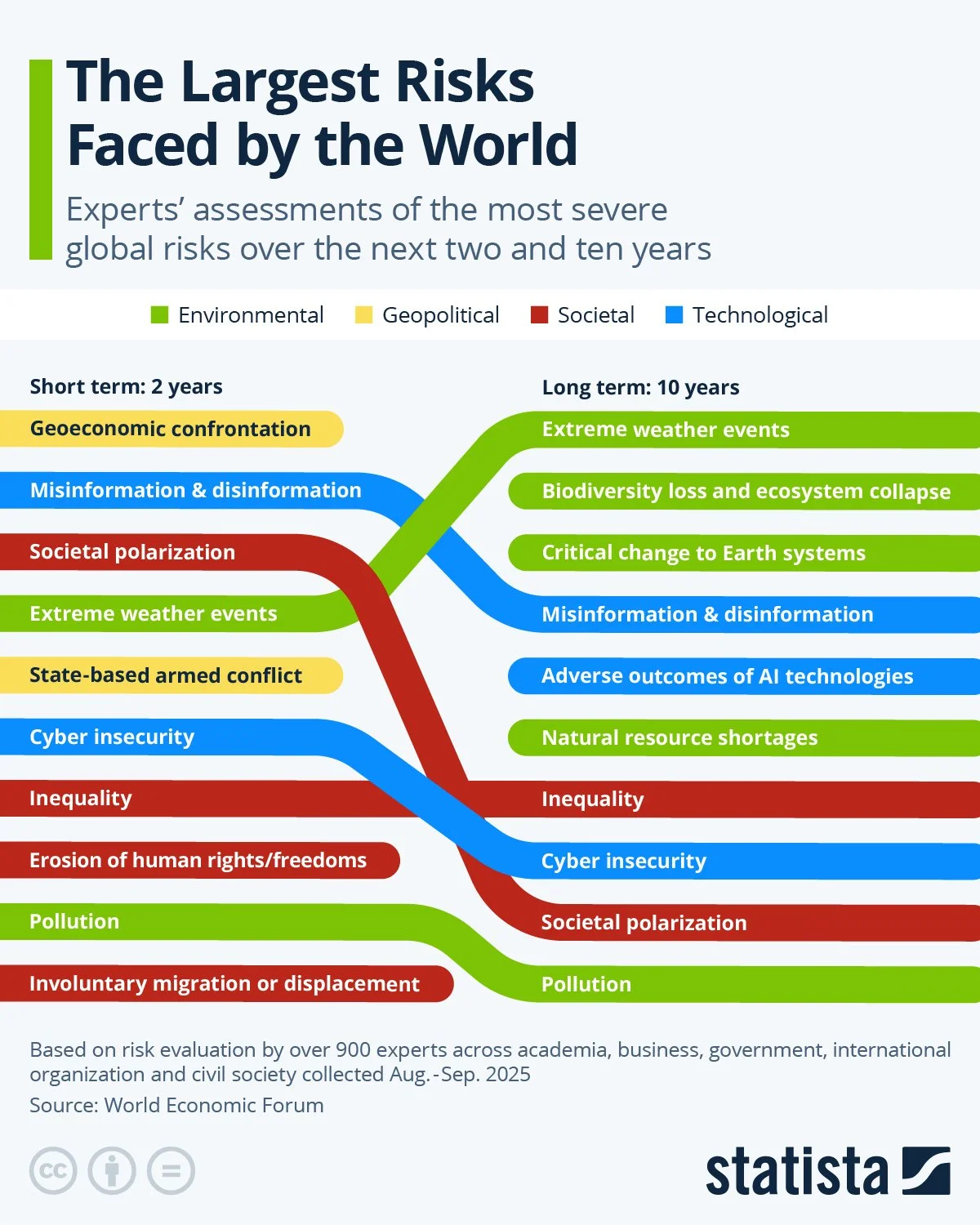
According to Statista research, many businesses already track commonly recognized global risks: climate change, geopolitical instability, cyber threats, and economic volatility. But every organization faces unique challenges based on location, industry, and business model.
What gray rhinos are specific to your situation? Your industry? Your geography? Build your customized list and matrix. The risks you identify today are the crises you can prevent—or at least prepare for—tomorrow.
The uncomfortable truth about gray rhinos is that we can see them coming. Our challenge isn’t awareness; it’s action. The question facing every leader is simple: Will you watch the rhino charge, or will you prepare for its arrival?
Gray shapes lie ahead. We call them unforeseen. Pretending helps no one.
Related articles
China’s one child policy ended 10 years ago but birth rates remain low | NPR
5 Rules for Companies Navigating Geopolitical Volatility | Harvard Business Review
As population trends shift, where will future workers come from? | Federal Reserve Bank of Dallas
Japan’s declining population creates risks and opportunities | The International
The impact of demographic change in Europe | European Commission
What Risks Will the World Face in the Short and Long Term? | Statista
Chips And Salsa: Bite-Sized News and Posts
“Not all growth is good growth.” Good growth builds on strong foundations. It compounds. Without a solid footing, growth collapses under its own weight.
As businesses enter an uncertain year, many are curbing their growth plans | Marketplace
Weird facts and a great Key & Peele video.
Six-Chart Sunday – Things That Make You Go Huh? | Bruce Mehlman’s Age of Disruption
Seven lies about AI.
7 Lies About AI. The Philosopher’s Guide To Staying Sane You Will Never Get | Substack
Everything now has AI, even if we don’t need it or want it.
CES Is Drunk on AI, While the Real Innovation Is Somewhere Else | CNET
Metrics are not objectives. Metrics are views of the past. They are useful, but they are not what matters.
The TV Editor Who Stopped Chasing Ratings And Doubled Them | Medium
I’ve been there and lived this more than once. A few times, I found the next gig in time. Others I was not so lucky.
My Manager Quit Right After Q3 Planning. We All Thought She Was Crazy. She Wasn’t. | Mediium
I had not heard of Putt’s Law before. There are two realities this article missed. Technical experts never know everything. Decision makers never know nothing. Representing these as a Venn diagram would be helpful. Managers need enough knowledge to make decisions. Technologists need enough understanding to temper recommendations with pragmatism.
Putt’s Law in Modern Management | Medium
A little bit of science.
Astronomers Spot Mysterious Bar-Shaped Cloud of Iron Inside an Iconic Nebula | Scientific American
Liquid gears could challenge 5,000 years of mechanical engineering | TechSpot
Mars was once a ‘blue planet': Ancient river deltas point to vast ocean | Phys.org
Quotes
“The trouble is, you think you have time.”
Buddha
“In a crisis, rumors will play a strong role in people’s behavior.”
Joan Donovan
“Fear defeats more people than any other one thing in the world.”
Ralph Waldo Emerson
Join the conversation.
Subscribe on LinkedIn, Medium, or Substack.
Leadership is the most important work we do—in business and in life. I've spent over 40 years working with leaders across more than 100 companies, and I'm still learning. These newsletters share my thoughts on leadership today and what we can learn.
I need your help making this better. What topics hit home? What misses the mark? What leadership challenges are you wrestling with right now? Send them my way.
Find The Leader With A Thousand Faces and other recommended books on my website.