Corporate Diplomacy: Stakeholder Value and the Modern Business Model

Photo by Lars Mai via Pexels
Recently, I attended a presentation titled "Stakeholder Capitalism – The Revolution That's Transforming the C-Suite." The session was hosted by Dr. Charles Dhanarag of Georgia State University, in partnership with Kettering – Success Accelerated. It featured Dr. Ed Freeman from the Darden School of Business at the University of Virginia. Known as the father of stakeholder capitalism, Freeman wasn't offering platitudes. He was describing a practical framework for how organizations create lasting value.
We've heard companies say they serve shareholders, customers, employees, partners, suppliers, and communities, but when consequential decisions are needed, too many narrow their focus to shareholder value alone. Many leaders focus on and often misinterpret Milton Friedman's Shareholder First Doctrine. Friedman believed that all executive decisions should be made with an understanding of their impact on organizational value.
Over time, many leaders have interpreted this to mean that the only measure that matters is shareholder value. That simplification has consequences. Activist investors take an even more extreme view, focusing on maximizing share price in the short-term at the expense of building an enduring, profitable enterprise. They don't manage businesses; they manage balance sheets and income statements. Famous examples include J.C. Penny, Toshiba, and Red Lobster.
Stakeholders are not abstractions. They are customers who choose, employees who commit effort, communities that grant legitimacy, partners who share risk, and shareholders who provide capital. I have thought about this issue before, but Dr. Freeman's presentation led me to view it in a new way. I often view the world with a Venn Diagram mental model. I created this one for Stakeholder Value.
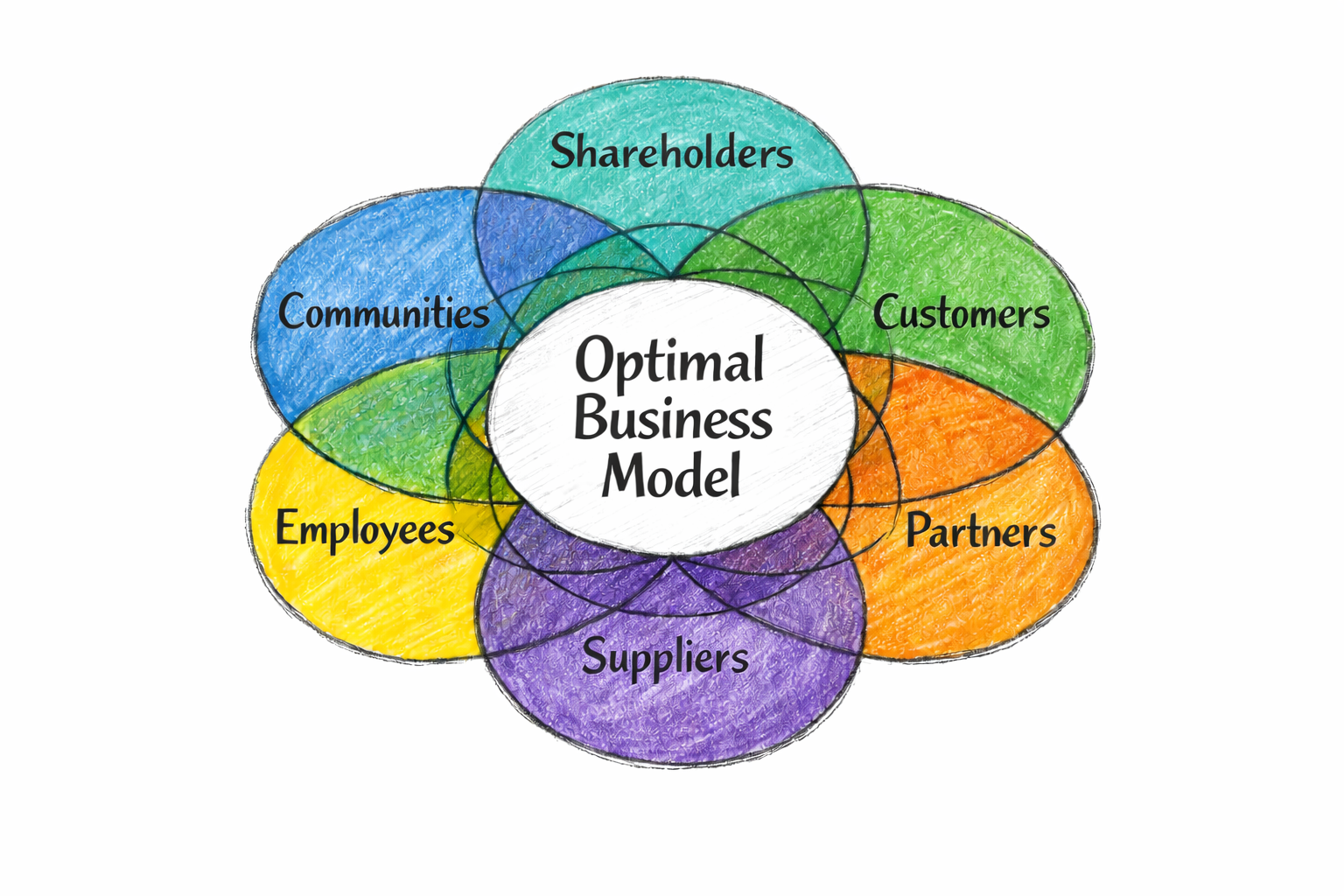
(Full disclosure: I used two AI platforms to build this image. It took multiple iterations to achieve the final result.)
Effectively managing stakeholder values results in what I believe is an optimal business model. My definition of an optimal business model is one that balances the needs of multiple communities of interest to build a thriving and lasting organization. To build something that lasts, leaders must accept two realities. First, all stakeholders have an essential role in a company's success. Second, stakeholders have different needs and definitions of success.
Achieving this Optimal Business Model requires what I describe as Corporate Diplomacy. Foreign diplomacy between nations demands clear objectives, cultural awareness, complex negotiation, and constant adaptation to change. Corporate diplomacy asks the same of leaders managing stakeholder relationships across organizations.
The diplomatic approach starts with a clear vision of what success means for the organization as a whole, not shareholder returns alone or stakeholder satisfaction as an end in itself, but a definition of value creation that acknowledges interdependence. Open dialogue comes next, because diplomats don't just broadcast positions but listen to understand interests, constraints, and non-negotiable values.
Cultural differences matter more than most leaders acknowledge in this diplomatic work. A mining company operating in a community with deep ties to the land faces different dynamics than one working in an industrial zone. An employee in Denmark has different expectations about workplace democracy than one in Singapore. Corporate diplomacy recognizes these variations without treating them as obstacles to overcome.
In many ways, these negotiations never end. As markets shift, technologies emerge, and regulations change, the balance point shifts. What worked well last year may fail in the next. Leaders who view stakeholder management as a problem to solve once will find themselves constantly surprised by breakdown and conflict. Those who embrace it as ongoing diplomacy build resilience through continuous adjustment to changing conditions.
Organizations that practice corporate diplomacy don't eliminate tension between stakeholder groups but create structures and practices for managing it productively. They build trust through consistent behavior, communicate clearly about tradeoffs, and demonstrate that serving multiple stakeholders isn't a constraint on value creation but the foundation for it.
This diplomatic approach has been essential to my career. From my undergraduate training in labor relations, negotiating multi-year service contracts, leading global teams, and guiding firms through M&A integrations, I have found that patient but urgent diplomacy yields tremendous value.
This work is rarely apparent in quarterly earnings reports. It creates value the way infrastructure creates value by making everything else possible. In Charles Duhigg's The Power of Habit, he shows how Alcoa's renewed focus on safety turned its financial performance around. Organizations with strong stakeholder relationships can move faster when opportunities emerge, weather crises better because trust doesn't evaporate at the first sign of trouble, and attract better talent, more loyal customers, and more patient capital.
Different needs converge. Patience shapes the overlap. Value grows for all.
Related articles
Six Principles for Win-Win Projects: A Stakeholder Theory Approach | UVA Darden
The case for stakeholder capitalism | McKinsey & Company
What stakeholder capitalism is and what it isn’t | World Economic Forum
How Shareholder Activism Became Toxic—and How to Fix It | Institute for New Economic Thinking
Does Shareholder Activism Split the Pie or Grow the Pie? | Harvard Law School
Chips And Salsa: Bite-Sized News and Posts
I recently wrote about existential crises. For many parts of the world, access to fresh water is one of these. For example, India is home to more than 15% of the world’s population, but only 4% of the world’s fresh water.
The world is in water bankruptcy, UN scientists report – here’s what that means | The Conversation
Multitasking is a myth when we talk about work. The best we can do is switch fast and hope we don’t lose anything in the process. In our personal lives, we just need to be present with our family and friends.
Forget multitasking, try monotasking | TED
The academic pursuit of perfectly precise language often leads to more confusion.
Economic vocabulary is a story that's hundreds of years in the making | Marketplace
Train your brain.
Grand visions without guardrails tend to waste a lot of money.
What was the metaverse? Fast Company
A while back I posted a book review of The Confidence Game: Why We Fall for it…Every Time. Cons come in many forms and with many intentions.
18 of the Greatest Con Artists Who Fooled the World | Medium
A very interesting article on project management. What happens when you cannot separate or replace team members?
Houston, We Have a Solution | Northwestern Kellogg
If you are reading this article, it is probably time to plan a career pivot. Do not forget that changing jobs does not always mean changing employers.
How to tell if it’s time for a career pivot | Fast Company
I have seen every movie on this list. I prefer the new Midway (2019) to the old (1976). I did not particularly care for Life is Beautiful. Instead of The Longest Day, I suggest watching the first few episodes of Band of Brothers. My personal favorite movie of all time, regardless of genre, is Casablanca; closely followed by King Kong (1933).
Movie Vault: The 15 Best WWII Films | Medium
Quotes
“About the time we think we can make ends meet, somebody moves the ends.”
Herbert Hoover
“For things to remain the same, things will have to change.”
Giuseppe Tomasi di Lampedusa
“Whether you take the doughnut hole as a blank space or as an entity unto itself is a purely metaphysical question and does not affect the taste of the doughnut one bit.”
Haruki Murakami
Join the Conversation
Subscribe on LinkedIn, Medium, or Substack.
Leadership is the most important work we do—in business and in life. I've spent over 40 years working with leaders across more than 100 companies, and I'm still learning. These newsletters share my thoughts on leadership today and what we can learn.
I need your help making this better. What topics hit home? What misses the mark? What leadership challenges are you wrestling with right now? Send them my way.
Find The Leader With A Thousand Faces and other recommended books on my website.